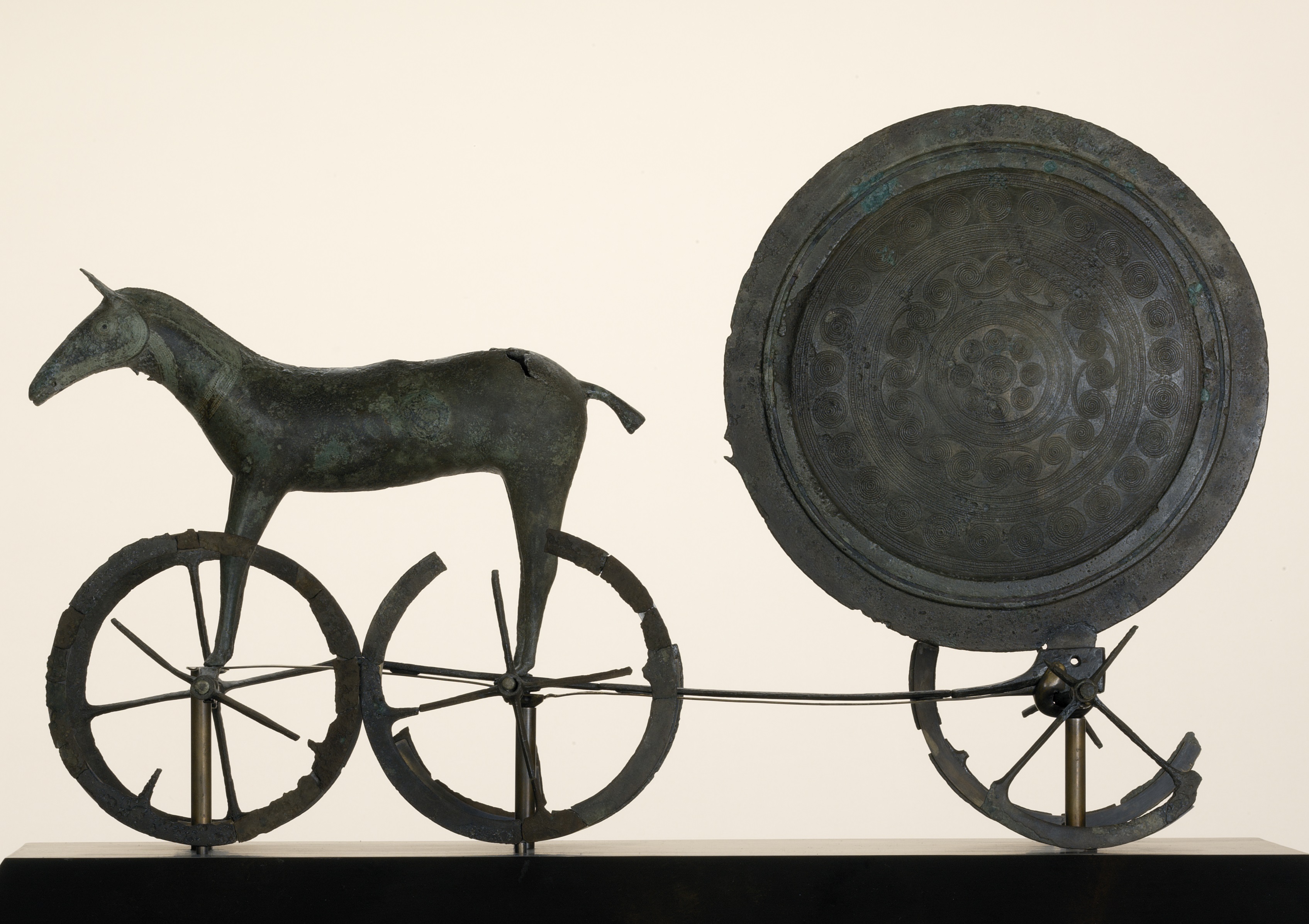



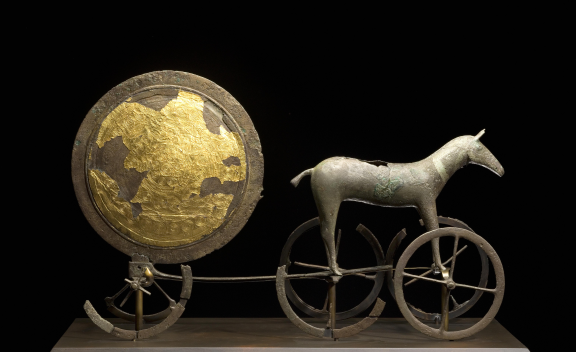
The Solar Wagon is a relic from the Nordic Bronze Age, discovered in Denmark. It depicts a solar chariot, featuring a bronze horse sculpture and a large bronze disk mounted on a device with spokes.
This sculpture was unearthed in 1902 in the peat bogs at Trundholm in Odsherred, located in the northwestern region of Zealand. It currently resides in the collection of the National Museum of Denmark in Copenhagen.
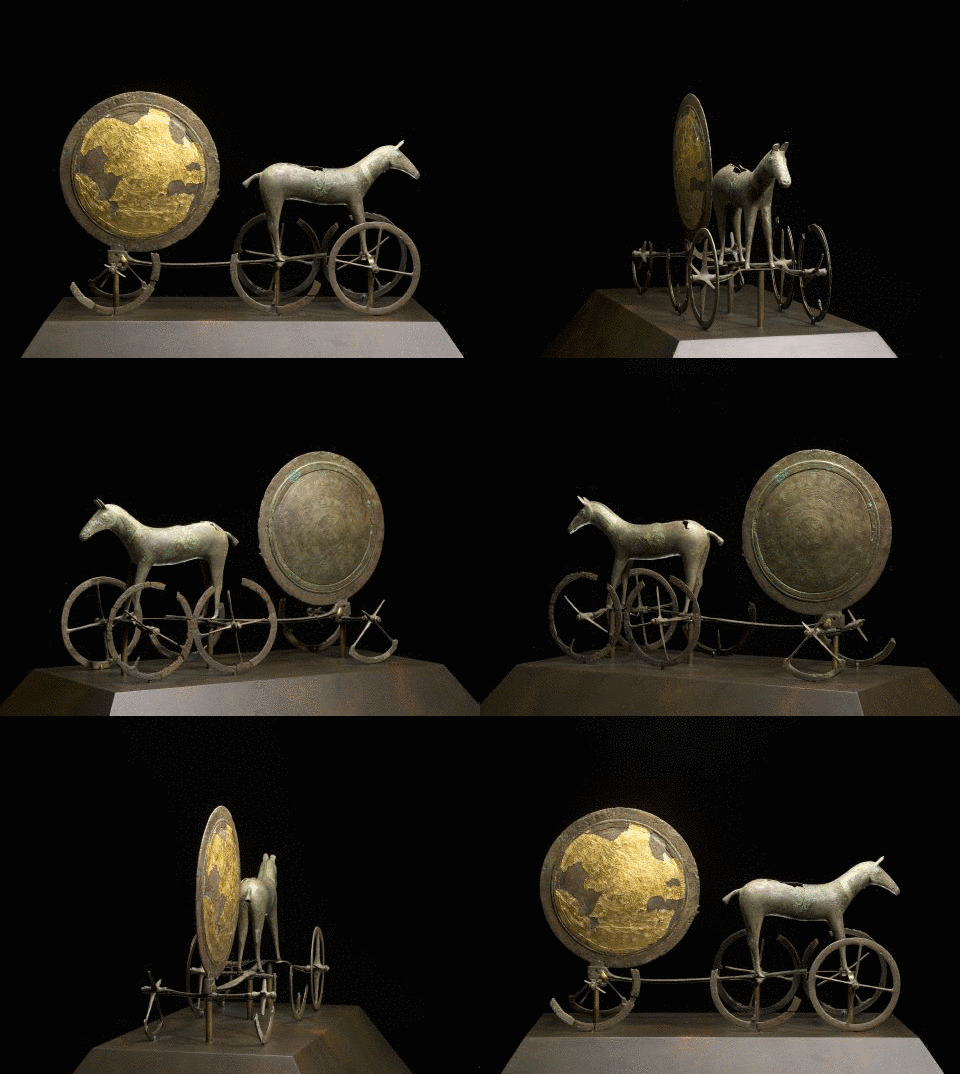
The bronze horse stands atop a bronze rod, supported by four wheels. The rod beneath the horse is connected to a disk, which is itself supported by two wheels. All of these wheels have four spokes. The artifact was created through the process of wax casting.
The dimensions of the entire object, including width, height, and depth, are approximately 54 cm × 35 cm × 29 cm (21 inches × 14 inches × 11 inches). The disk itself has a diameter of about 25 cm (9.8 inches). It is gilded on one side, specifically the right side when viewing the horse from behind. The disk consists of two bronze discs connected by an outer bronze ring, with a thin layer of gold applied to one side. These discs were then adorned with punches and incisions featuring concentric circle motifs, with zigzag patterns between the edges. The gold side includes an outer zone that may symbolize sun rays, as well as an area with concentric circles connected by winding strips, which appear to progress like dance steps—moving forward twice and backward once. The main features of the horse are also intricately decorated.
The two sides of the disk have been interpreted as symbolic representations of the belief that the Sun traverses the sky from east to west during the day, presenting its bright side to Earth, and then returns from west to east at night, revealing its dark side. This movement mirrors the Sun's apparent journey across the Earth. It is believed that this chariot may have been used in religious ceremonies to demonstrate the Sun's celestial path.
The National Museum has assigned a date of approximately 1400 BC to the sculpture, although alternative dating methods have been proposed. It was unearthed before the advent of pollen dating, which would have provided a more precise timeframe.
What's particularly surprising is the presence of a model depicting a spoked-wheeled horse-drawn carriage in Northern Europe during such an early period. Typically, such carriages weren't expected to appear until the late Bronze Age, spanning from 1100 BC to 550 BC.
Klavs Randsborg, a Professor of Archaeology at the University of Copenhagen, has pointed out an intriguing pattern in the disk's design. The sum of the number of spirals within each circle on the disk, multiplied by the number of circles they're found in, when counted from the middle (1x1 + 2x8 + 3x20 + 4x25), equals a total of 177. Remarkably, this figure is very close to the number of days in six synodic months, differing only by 44 minutes and 2.8 seconds each.
The synodic cycle represents the time elapsed between two consecutive conjunctions of an object in the sky, like a specific star with the Sun. It signifies the duration it takes for the object to reappear at the same point in the sky when observed from Earth, making it an easily observable orbital period from our planet.
Randsborg contends that this pattern suggests that the disk was crafted by an individual with a degree of astronomical knowledge, possibly allowing the sculpture to function as a calendar.