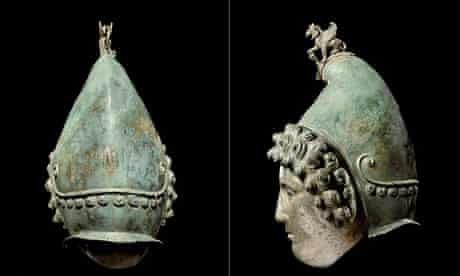


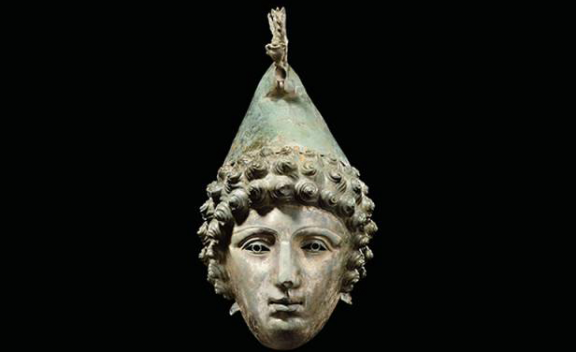
The Crosby Garrett Helmet is a remarkable archaeological discovery—a copper alloy Roman cavalry helmet dating from the late 2nd or early 3rd century AD. It was found by an unnamed metal detectorist near Crosby Garrett in Cumbria, England, in May 2010. This helmet is a testament to the presence of a Romano-British farming settlement in the area where it was discovered, which was located a few miles from the Roman road and fort of the Roman army. It is plausible that the helmet's owner was a local individual who served in the Roman cavalry.
The helmet was found deliberately folded and placed within an artificial stone structure. It is believed to have been used for ceremonial purposes rather than combat and may have been considered an antique by the time it was buried. This helmet shares characteristics with the Newstead helmet (discovered in 1905) and exhibits design similarities to the Ribchester helmet (found in 1796) and the Hallaton helmet (found in 2000). However, its facial features are more reminiscent of helmets found in southern Europe. The design of the helmet may allude to the Trojans, whose stories and exploits were reenacted by the Romans in cavalry tournaments.
Ralph Jackson, senior curator of Roman-British collections at the British Museum, described the helmet as an "extremely interesting and extremely important find." Its face mask is finely crafted and strikingly impressive, but it is the entirety of the helmet that sets it apart, making it an unparalleled artifact with unique characteristics. The helmet holds immense national and international significance.
On October 7, 2010, the helmet was auctioned at Christie's for £2.3 million ($3.6 million) to an undisclosed private buyer. Tully House Museum and Art Gallery in Carlisle attempted to purchase the helmet with support from the British Museum but was outbid. The helmet has been publicly displayed on four occasions: first at the 2012 exhibition at the Royal Academy of Arts, then at Tullie House in 2013-2014, followed by the British Museum in 2014, and subsequently returning to Tullie House for display at the Hadrian's Cavalry exhibition in the summer of 2017.