





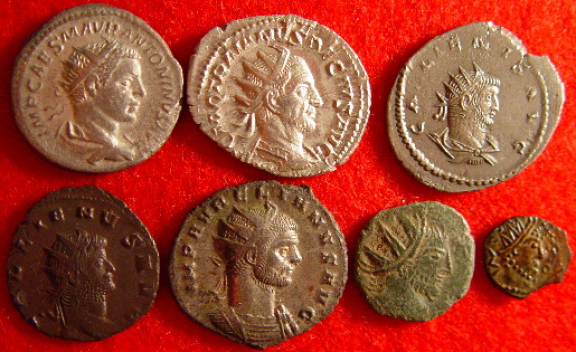
The hoard discovered in Bath, Somerset, stands as a significant archaeological find, ranking as the fifth-largest hoard ever found in Britain and the largest ever unearthed in a British Roman city. This remarkable collection comprises approximately 17,500 Roman silver coins, dating from as early as 32 BC to AD 274. The treasure was discovered on Bo Street, situated about 150 meters from the Roman baths of the city, which were constructed during the time when Bath was a Roman colony known as Aquae Sulis.
In 2008, archaeologists from Cotswold Archaeology made the discovery while excavating the site for a new pool at the Gainsborough Hotel and Thermal Spa. The building itself, a Grade II listed structure, was originally erected in the 1820s by John Pinch Sr. as the United Hospital of Bath and later became part of the Bath Technical College. Notably, the location of this find is in close proximity to the Roman baths and the original temple of Minerva.
Historically, the site had been excavated in the 1860s by James Irwin when architects George Phillips Manners and George Phillips expanded the building during its conversion into a hospital addition. Irwin's excavations revealed a Roman bathing complex featuring a hypocaust floor. However, it remains uncertain whether this complex was part of a private villa or a public structure.
The Boe Street hoard, identified as the largest hoard ever discovered in Great Britain by a professional archaeologist, presented a unique configuration. The coins were discovered fused together into a large block, concealed beneath the floor of a Roman building near the face of a stone wall, within a small oval hole measuring approximately 40 cm by 30 cm (16 inches by 12 inches). The find's location was highly unusual, as hoards are typically associated with rural areas. Initially believed to have contained as many as 30,000 coins, the estimated count was later revised to 17,400 coins. Conservators at the British Museum have identified coins spanning from 32 BC to AD 274, suggesting that the hoard was deposited in the late 3rd century AD. This discovery provides valuable insights into the history and economy of Roman Bath, shedding light on its wealth and the context of its time.