



The Sundveda Hoard is a Viking-era collection of 482 silver coins discovered in 2008 in Sundveda, located between the towns of Märsta and Sigtuna near Stockholm, Sweden. Notably, it stands as the largest silver hoard found in the Mälaren region since 1827.
Archaeologists from the Swedish National Heritage Board made this remarkable discovery during a survey of a grave in Sundveda. The survey was initiated by the Stockholm County Administrative Board as part of the preparatory work for a new residential area's construction.
The find, considered a surprise, prompted a more comprehensive investigation of the grave. Alongside the silver hoard, the grave contained bone fragments and other small objects. Analysis revealed that the bones belonged to an individual who lived in the mid-7th century, approximately 200 years before the treasure was placed there. In contrast, fragments of charcoal from the tomb were dated to about 100 AD. Archaeologists speculate that the site may have had three distinct periods of use: an initial construction phase in the first or second century without burials, a burial around 500 years later, and ultimately the deposit of the silver hoard during the Viking era. Various theories surround why the hoard was buried at this location. The silver coins might have been received as payment for trade in the Baltic countries or Russia, or they could have served as payment to a local resident who worked as a mercenary abroad.
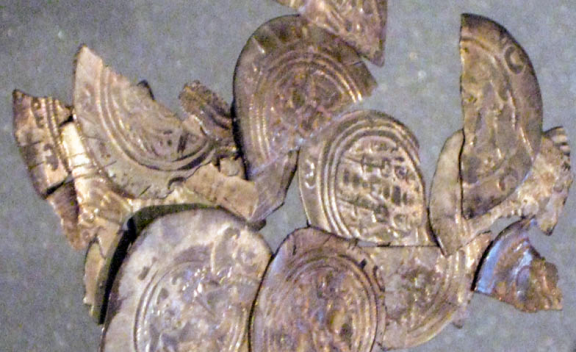
This hoard, consisting of 482 coins, is primarily of eastern origin, with only one being a Carolingian coin. At the time of discovery, 109 coins were intact, while the others were either damaged or fragments. Based on the manner in which the coins were found, it's possible that they were placed in the grave within a sack. These coins originated from a wide geographic range, including North Africa, modern Iran, Russia, the Arabian Peninsula, and northern India. The oldest coins belong to the pre-Islamic period, with the most common category of coins coming from the Abbasid Caliphate. Some of these coins were minted in Baghdad and Damascus.
Based on the age of the coins, it's likely that the hoard was deposited at this site no earlier than the middle of the ninth century, making it one of the earliest Viking Age hoards discovered on the Swedish mainland.
The total weight of the treasure amounts to about 660 grams (23 ounces). In 2008-2009, the hoard was publicly displayed at the Sigtuna Museum in Sigtuna.