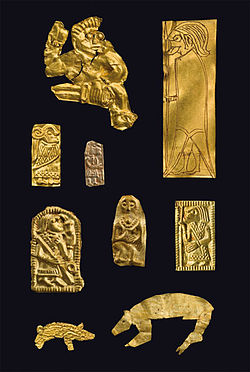


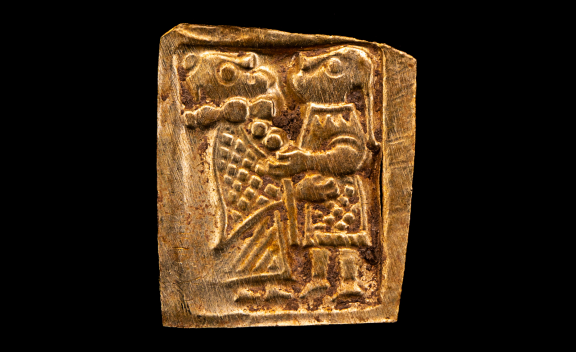
Gullgubber are remarkable artifacts from the Nordic Iron Age found in Scandinavia. These objects are typically small, thin pieces of hammered gold (sometimes silver), measuring around 1 to 2 square centimeters (0.16 to 0.31 square inches). They are adorned with stamped motifs and are considered some of the oldest examples of toreutics (metalwork) in Northern Europe.
The term "gullgubbe" means "little golden oldies" and was coined based on a report published in 1791 by Niels Henrik Sjöborg. In this report, Sjöborg mentioned that villagers in Ravlund, Scania, who discovered these artifacts in the dunes, referred to them as "guldgubbar."
Approximately 3,000 gullgubber have been found in various locations across Norway, Sweden, and Denmark. Denmark yielded the largest number of these artifacts, with over 2,350 discovered in the settlement of Sorte Muld on the Danish island of Bornholm. Additionally, more than 100 were found in Lundeborg, near Gudme on the Danish island of Funen, and 122 were uncovered in Uppakre, Scania, Sweden. However, relatively fewer pieces have been found in Norway, although a notable discovery occurred during excavations at Vingrom Church in Oppland between 2003 and 2005.
These gullgubber belong to the Late Iron Age, spanning from the end of the Age of Migration to the beginning of the Viking Age. They are particularly associated with the Merovingian Age in Norway and the Wendel Age in Sweden, a timeframe approximately from 550 to 800 AD. However, dating these artifacts can be challenging because they are often found in contexts that do not provide a precise date. It is likely that gullgubber replaced brakteates, which required more metal, when obtaining gold from the Byzantine Empire became increasingly difficult.
Gullgubber serve as valuable archaeological evidence, shedding light on the craftsmanship and artistic expressions of the people in the Nordic Iron Age. They provide insights into the socio-cultural and historical dynamics of the time, including the influence of Byzantine gold on Northern European art and ornamentation.