



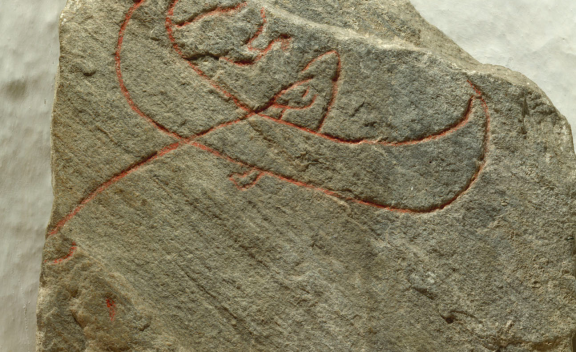
The Hørdum Stone is a Viking painting stone that was discovered in Hørdum, Tystede, in the Northern Denmark region. This stone depicts a legendary scene from Scandinavian mythology involving the god Thor and the serpent Jörmungandr, also known as the Midgard Serpent.
The Hørdum Stone was found in 1954 during trenching work near the Hørdum church. Much like other runic and picture stones of its time, it was reused as a construction material in roads, bridges, walls, and buildings before the historical significance of these stones was fully understood.
The image on the stone illustrates a legend recorded in the "Hymiskviða" section of the Poetic Edda, in which the Norse god Thor goes fishing for Jörmungandr, the great serpent that encircles the world. In this story, Thor fishes with the giant Hymir, using a bull's head as bait. Thor manages to hook Jörmungandr, but either the serpent breaks free or, as stated in the "Gylfaginning" section of the Prose Edda, the line is severed by Hymir. According to the Prose Edda, while Thor was pulling the line with Jörmungandr on the hook, his feet went through the bottom of the boat, resulting in a dramatic encounter.
The image on the Hørdum Stone depicts Hymir, Thor, the fishing line, and part of the serpent. Notably, Thor's leg pierces the hull of the boat. While the bull's head bait is not shown, it may have been present in the part of the image that has worn away over time. Hymir is depicted with a tool, seemingly preparing to cut the fishing line, which aligns with the version of the myth told in the "Gylfaginning."
This scene of Thor's encounter with Jörmungandr appears to have been a popular motif in Scandinavian art. Other stones and artifacts, such as Ardre VIII, the Runestone of Altun, and the Cross of Gosforth, also feature images connected to this myth. The Hørdum Stone is now on display in the Hørdum church, offering a tangible link to Norse mythology and history.