



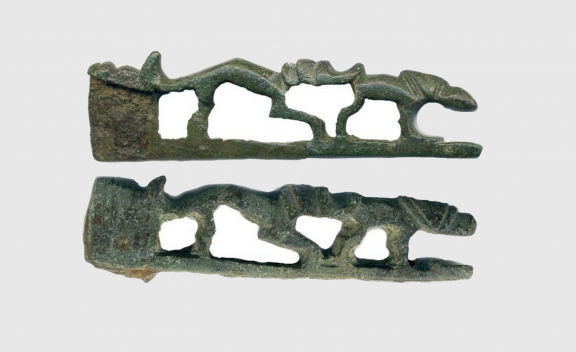
This description pertains to an incomplete Roman knife crafted from copper alloy and iron, shaped like a hare and a hound. The knife's handle is intact and showcases a stylized hound pursuing a running hare. It features a robust rod with a groove along its length, designed to accommodate the knife blade. The depicted animals have elongated limbs, with the hound keeping its snout close to the hare's tail. The hare has distinct long, triangular ears laid back on its head. The hound is depicted in a large, full-speed pursuit, with its front legs outstretched, ears pinned back, and its lengthy tail arching upwards. The flat, rectangular buttstock exhibits vertical protrusions at both ends. Remnants of an iron blade, fastened by an iron rivet through the buttstock, can be observed between the hind legs of the hound and in the slot below the handle.
These motifs display significant stylization and might not have been recognizable if more lifelike examples of similar objects hadn't been discovered elsewhere. The knife's blade was originally made of iron but has mostly corroded over the course of more than 1,500 years of burial.
This knife's handle was discovered in a grave located within Winchester's northern Roman cemetery. Its age is estimated to be 45 years or older, and the gender of the individual couldn't be determined from the remains. However, such implements are typically associated with male burials. Another similar Roman knife was found alongside other Roman artifacts intentionally interred as grave goods in an Anglo-Saxon grave in Worthy Park. Both items are currently on display at the City Museum, with this one featured in the Venta Gallery and the Worthy Park item showcased in the Wintancester Gallery.