




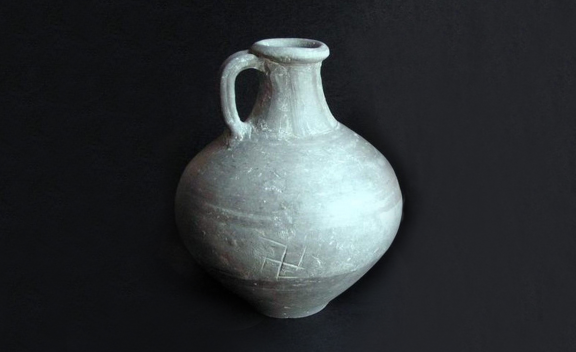
The gray ware jug discovered at Manor Farm in Hurstbourne Priors, Hampshire, is an intriguing archaeological find that likely dates back to the Roman era, specifically around 200-279 AD. This type of jug was created in the kilns located in Alice Holt, near Farnham in Surrey.
The jug features a distinctive design, with a rim and the upper half of its torso intact. Notably, it bears vertical burnt lines on the neck, adding to its uniqueness. What makes this jug even more interesting is the presence of graffiti in the form of a swastika, which was likely used as an identifying mark by its owner or creator.
The dating of this type of pottery to around 200-280 AD aligns with the late 3rd century, suggesting that the burial associated with this artifact occurred during that period. However, the presence of ancient samian ware, which can be traced back to approximately 270 AD, adds complexity to the artifact's history. It's possible that the samian ware had significant historical or ritualistic value and may have been considered a hidden relic before being placed in the grave, providing valuable insights into the beliefs and practices of the time.