



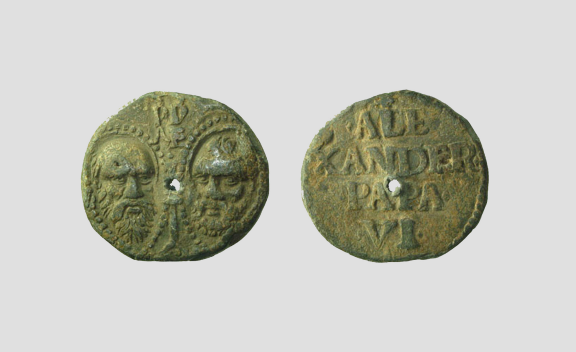
The lead seal, or bulla, discovered at the Hyde Abbey site in Winchester, Hampshire, dates back to the Middle Ages, specifically during the papacy of Pope Alexander VI, who reigned from 1492 to 1503. A bulla was typically attached to certain types of letters of patent or charters known as papal bulls, serving as an authentication mark for the document.
Pope Alexander VI, a member of the Borgia family, is indeed remembered for his controversial and secular actions as pope, characterized by nepotism and the granting of titles and favors to his illegitimate children. Among the notable bulls issued during Alexander VI's papacy was one that granted the Spaniards exclusive rights to territory and commerce in lands discovered by Christopher Columbus in the New World.
In this specific case, the bulla would have been attached to the papal dispensation issued by Pope Nicholas IV in 1288. This dispensation allowed the monks of Hyde Abbey to wear hats made from sheep or lamb skins during religious services and processions. The reasoning behind this permission was the acknowledgment of the cold climate in the region, which was believed to cause paralysis and illness in some individuals. Undoubtedly, the monks of Hyde Abbey would have welcomed this special dispensation granted to them by the papal bull.