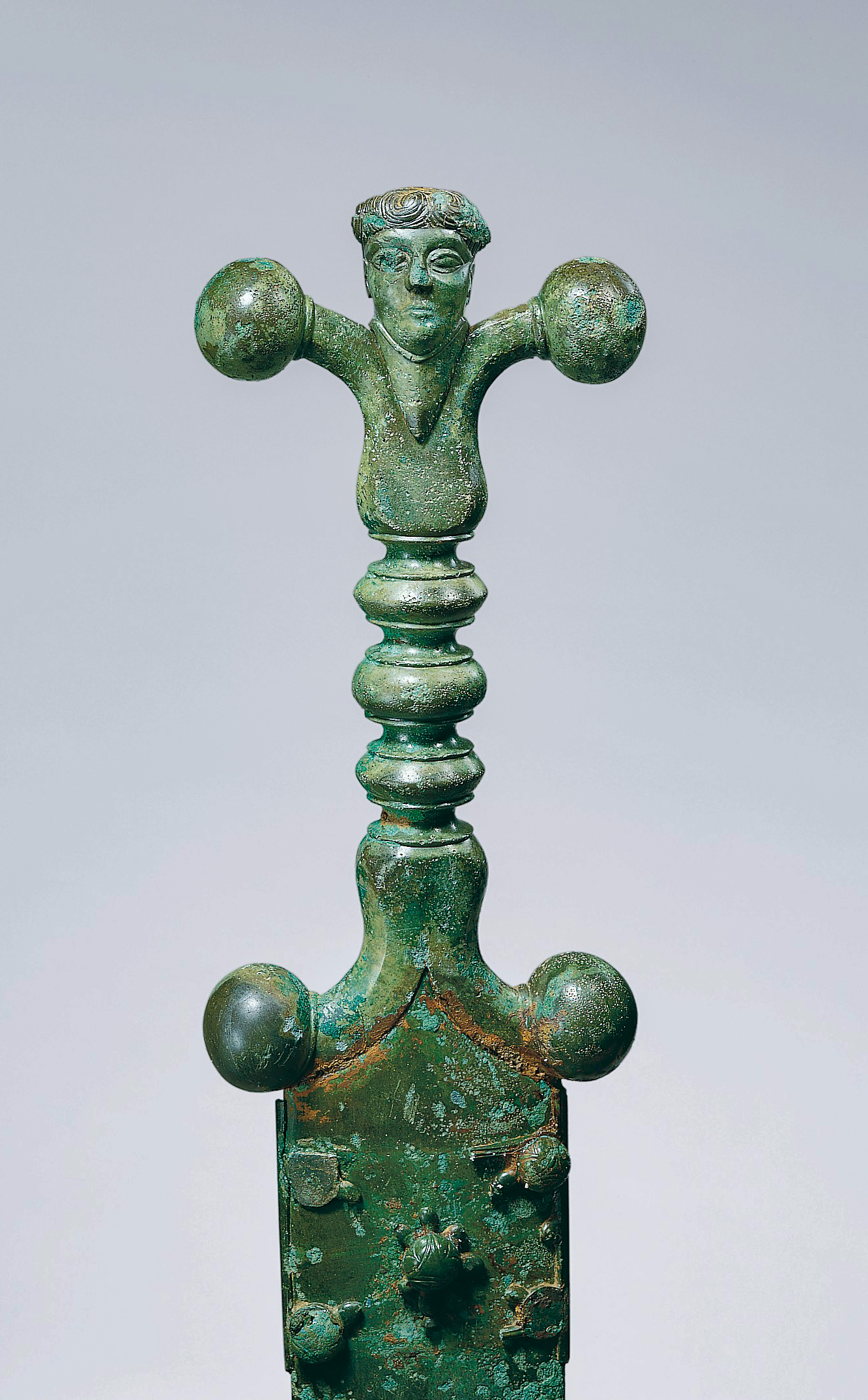


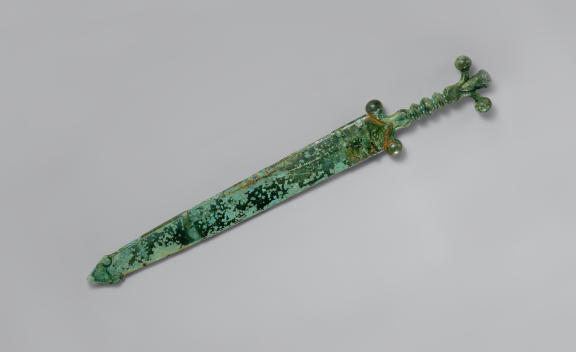
This magnificent anthropomorphic Celtic sword, believed to date from around 60 B.C., is a remarkable artifact. It is considered one of the best-preserved examples of its kind. The sword features a beautifully modeled hilt with a head that completes its design, depicting a Celtic warrior.
The hilt of this sword is distinctive in its human-like form, resembling a geometric reduction of a classical warrior. It was believed that such a design would not only enhance the strength of the wearer but also carry talismanic significance. The hilt's features are meticulously rendered and include a face with large almond-shaped eyes, an omega-shaped head, and finely drawn hair, all of which are clearly articulated.
While the scabbard is fused with the iron blade, affecting a portion of its surface, the overall ornamentation and exquisitely worked hilt stand as a testament to the technical prowess of the Celts, who were influential conquerors in ancient Europe. This sword is associated with the La Tène culture, named after a significant Celtic settlement located near Lake Neuchâtel in what is now Switzerland and eastern France. Similar anthropomorphic swords have been found in various locations, including France, Ireland, and the British Isles, reflecting the widespread influence and presence of the Celts throughout Europe.
As the first specimen of its kind in the museum's collection, this Celtic sword is a superb and unique example, enriching the collection with its cultural and historical significance. It provides valuable insights into Celtic artistry and craftsmanship during this era.