



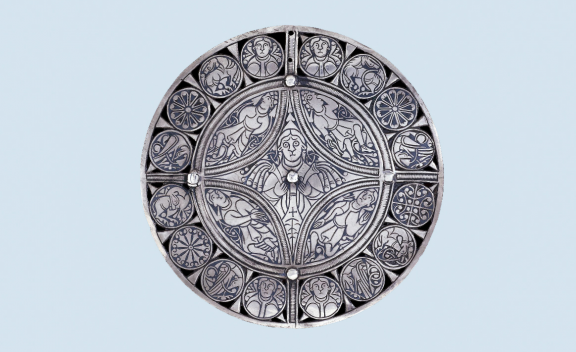
This Late Anglo-Saxon brooch, created in the Trewhiddle style during the late 9th century, hails from the British Isles in Europe. It is a circular brooch crafted from forged sheet metal and possesses a slightly convex cross-sectional profile. The brooch is notable for its rich niello inlay work and features an openwork outer zone surrounding a central circle, which is framed and divided by a wide, textured border into a central rhombus and four additional lentil-shaped fields. In these fields, four bosses are placed at the points of intersection, with a fifth one positioned in the center. Three of these bosses hide the rivets that once attached the pin mechanism, which is now lost.
The decorative motif on this brooch revolves around personifications of the five senses within the central circle, encircled by an openwork zone comprising smaller circles containing alternating geometric designs featuring animals and humans. These motifs symbolize various aspects of creation, though not in a completely symmetrical arrangement.
The central field prominently features the personification of Sight, depicted as a three-quarter height figure with large oval eyes. Sight holds drooping foliate sprays with double jagged details in each hand, with a three-stepped leaf above the head and triquetras on either side. The circular field's border is adorned with dots and lozenges, each featuring a domed rivet, creating four lenticular panels. Each panel portrays a full-length human figure representing one of the other senses. These figures are attired in short jackets and belted tunics. The remaining background is filled with intricate foliage patterns.
In the upper left corner, Taste is depicted holding a mouth with one hand and a leafy stem with the other, while in the upper right corner, Smell is portrayed in profile, surrounded by two plants, and holds hands behind the back. The sense of touch, positioned in the lower right corner, has folded hands, and Hearing, in the lower left corner, appears to be running with a hand held to the ear. The entire composition is set against a dark background.
The reverse side of the brooch is plain, and the pin mechanism is missing. Two small holes at the top may have served for hanging the brooch.