




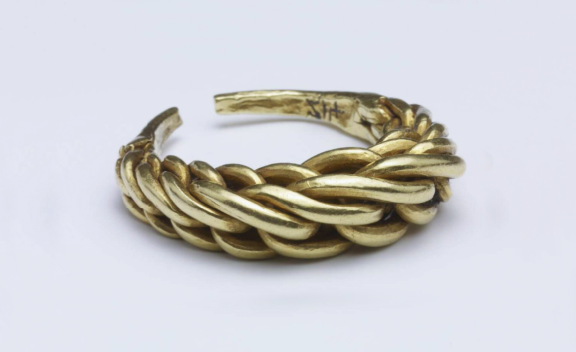
This is a Viking-era gold finger ring, crafted during the 10th to 11th centuries. It was found in Oxford, Oxfordshire, England, within the British Isles.
The ring is made of gold and features a unique design. It consists of six braided gold rods that form a round shape, tapering toward the ends. The ends of the rods are bunched together to create a simple narrow band. It's worth noting that the ring has split apart in one place, but this is believed to have occurred in antiquity, as both ends of the split are smooth.
Originally, the find location of this ring was listed as St. Aldates Street, Oxford. However, recent research by James Graham-Campbell has determined that the actual location of the find is Queen Street in Oxford.
The shape of the ring's hoop has evolved over time and now appears semi-oval. It's possible that the ends of the ring may have originally been joined, but this aspect has changed over the centuries. This gold finger ring is a valuable artifact, reflecting the craftsmanship and design aesthetics of the Viking era in England.