



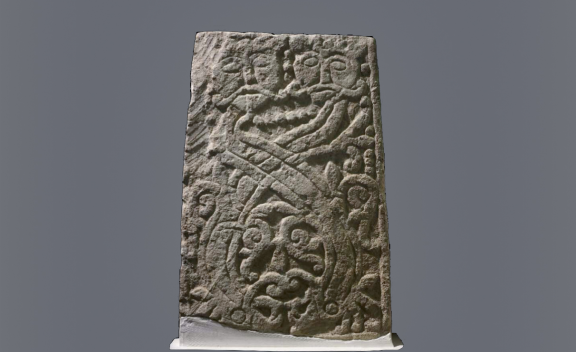
This tombstone, created in the early 11th century, represents a fascinating blend of Viking and Late Anglo-Saxon cultures and is associated with the Ringerike style. It was discovered in Bibury, Gloucestershire, England, within the British Isles.
The tombstone has a conical shape and is adorned with intricate carvings. On one side of the tombstone, you'll find two human masks with distinctive mustaches positioned at the ends of a foliate weave motif. These masks are likely representations of individuals and are a characteristic feature of the Ringerike style, which was prevalent during the Viking Age.
On the other end of the tombstone, there are two animal heads. These animal heads are also typical of Viking art and often appear in the Ringerike style as well. They are often stylized and intricately carved, contributing to the overall ornate design of the tombstone.
This tombstone provides a valuable glimpse into the artistic and cultural influences of the Viking and Late Anglo-Saxon periods, with its incorporation of elements from the Ringerike style. It is a significant historical artifact that reflects the craftsmanship and iconography of its time.