



Certainly, here's a rephrased version of the text you provided:
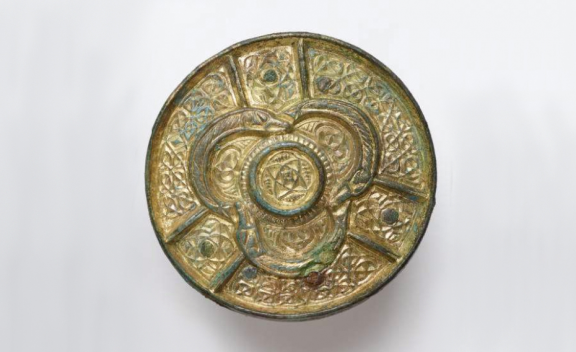
Cultural and Temporal Context: Reflecting Viking and Celtic influences, originating in the late 8th to 9th centuries
Excavation Location: Unearthed in Europe, specifically in Scandinavia, in the Namdalen region of Nord-Trøndelag, Norway, at Lilleberge
Materials: Made from a combination of iron, copper alloy, gold, and tin
Craftsmanship Technique: Crafted with gilding and tinning, and converted for use as a disc brooch through the addition of iron fitting pins riveted to the reverse
Description: This gilded copper alloy mount, with a tinned edge, has been adapted for use as a disc brooch. The decorative elements are cast and include a border featuring three panels of running knot weave, separated by three smaller subrectangular weave panels. These encircle three leaping, dolphin-like creatures arranged nose to tail in an arcade formation around a raised central circle. These creatures have distinct long muzzles, teary eyes, and tapered, patterned bodies. The central circle contains a quatrofoil motif and is surrounded by a plastered border. This border is set apart from the creatures' bellies by three panels adorned with interlacing knots positioned between pairs of ribbed triangles. Flat ribs serve as separators between the panels and the central circle.