



In Norse mythology, the Kerlaugar (plural form of Old Norse kerlaug "kettle-bath",) i.e. "bath-tub", are two rivers through which the god Thor wades. The Kerlaugar are attested in the Poetic Edda, compiled in the 13th century from earlier traditional material, and in a citation of the same verse in the Prose Edda, written in the 13th century by Snorri Sturluson.
Attestations
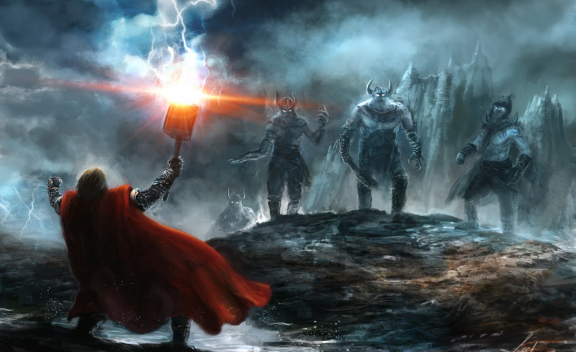
The Kerlaugar are mentioned once in the Poetic Edda. In the Poetic Edda poem Grímnismál, Grímnir notes that the bridge Asbrú "burns all with flames" and that, every day, the god Thor wades through the waters of Körmt and Örmt and the two Kerlaugar:
In Norse mythology, the Kerlaugar is a term that refers to two rivers through which the god Thor wades. The word "Kerlaugar" is the plural form of the Old Norse term "kerlaug," which means "kettle-bath" or "bath-tub." These rivers are mentioned in the Poetic Edda, a collection of Old Norse poems, and are also cited in the Prose Edda, a work by Snorri Sturluson from the 13th century.
The Kerlaugar rivers are described as part of Thor's daily routine in the poem Grímnismál from the Poetic Edda. In this poem, it is stated that Thor must wade through the waters of Körmt, Örmt, and the two Kerlaugar every day on his way to attend a council meeting at Yggdrasil's ash tree. The bridge called Asbrú, which he crosses, is said to be engulfed in flames, and the holy waters of these rivers boil.
The Prose Edda also mentions the Kerlaugar twice. In Gylfaginning, High explains that Thor wades through rivers to attend court, and he quotes the relevant stanza from Grímnismál. In Skáldskaparmál, the Kerlaugar are listed among other rivers in the Nafnaþulur.
The exact meaning and significance of the Kerlaugar are not entirely clear, and scholars have proposed various theories. Rudolf Simek finds the meaning of the term "strange" and suggests it may point to a lost myth about Thor. Guðbrandur Vigfússon related the term to Irish river names that begin with "Ker-" or "Char-" and rendered it as "Charlocks." John Lindow suggests that Thor's frequent crossings of rivers in Norse mythology may symbolize his interactions with the realm of the jötnar (giants), as they often dwell across boundaries and are associated with water, citing the sea serpent Jörmungandr as an example.
In the Prose Edda, the rivers are mentioned twice, once in Gylfaginning and once in Skáldskaparmál. In Gylfaginning, High says that Thor wades through rivers to go to court, and then quotes the above cited Grímnismál stanza in support. In Skáldskaparmál, the Kerlaugar appear in the list of rivers in the Nafnaþulur.
Theories and interpretations
Rudolf Simek comments that the meaning is "strange" and may point to an otherwise lost myth about Thor. On the other hand Guðbrandur Vigfússon argued that it and several other river names in the same poem were Irish in origin and related it to river names beginning in Ker- or Char- such as Cherwell. He and Frederick York Powell rendered it "Charlocks" in Corpus Poeticum Boreale.
Thor frequently crosses rivers in the mythology; John Lindow suggests this is due to the large amount of time he spends in the realms of the jötnar, "who live on the other sides of boundaries", and points to a symbolic connection between jötnar and water, citing the ocean-dwelling Jörmungandr as an example.