



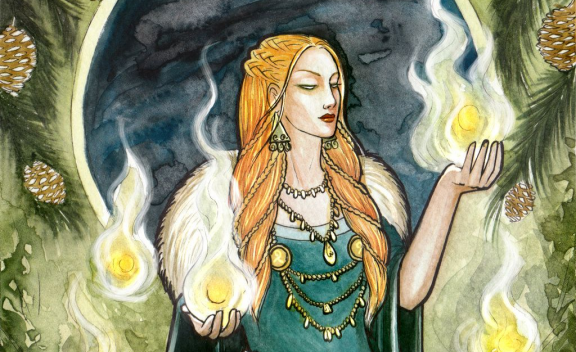
The primal goddess in question goes by two names, Laufey and Nal, and these names can be used interchangeably. However, they each represent distinct aspects of her character. In the more well-known accounts, she is depicted as Laufey, the wooded or leafy isle, who was ignited by the lightning of Farbauti, the Cruel Striker. This fiery event led to the birth of Loki, and it hints at Loki's own fiery nature, inherited from both his mother and father. Loki acknowledges his maternal lineage by using the name Laufeyson.
In an alternate guise, Laufey and Farbauti are known as Nal and Bergelmir, and they play a crucial role in the Norse version of the universal flood myth. This catastrophic flood, caused by the blood of the androgynous giant Ymir, engulfs the entire world and wipes out the early giants, with the exception of Nal and Bergelmir. They managed to find safety in Jotunheim by taking shelter under one of the beams of the World Mill.
In the Vafthrudnismal, there is another rendition of this legend, where Vafthrudnir mentions the oldest thing he recalls, which is the birth of Bergelmir. He suggests that Bergelmir was "laid on a mill," possibly implying that Bergelmir, like Ymir, was ground on the world mill. In a broader esoteric context, this phrase may symbolize the creative role of Bergelmir and Nal as the progenitors of the new Jotun race.
However, a more specific interpretation suggests that the mill and the mill beam are metaphors for Nal, whose name means vessel and carries a similar creative symbolism to the mill itself. Bergelmir being laid on Nal the mill symbolizes the procreative process that led to the creation of the new Jotun race.
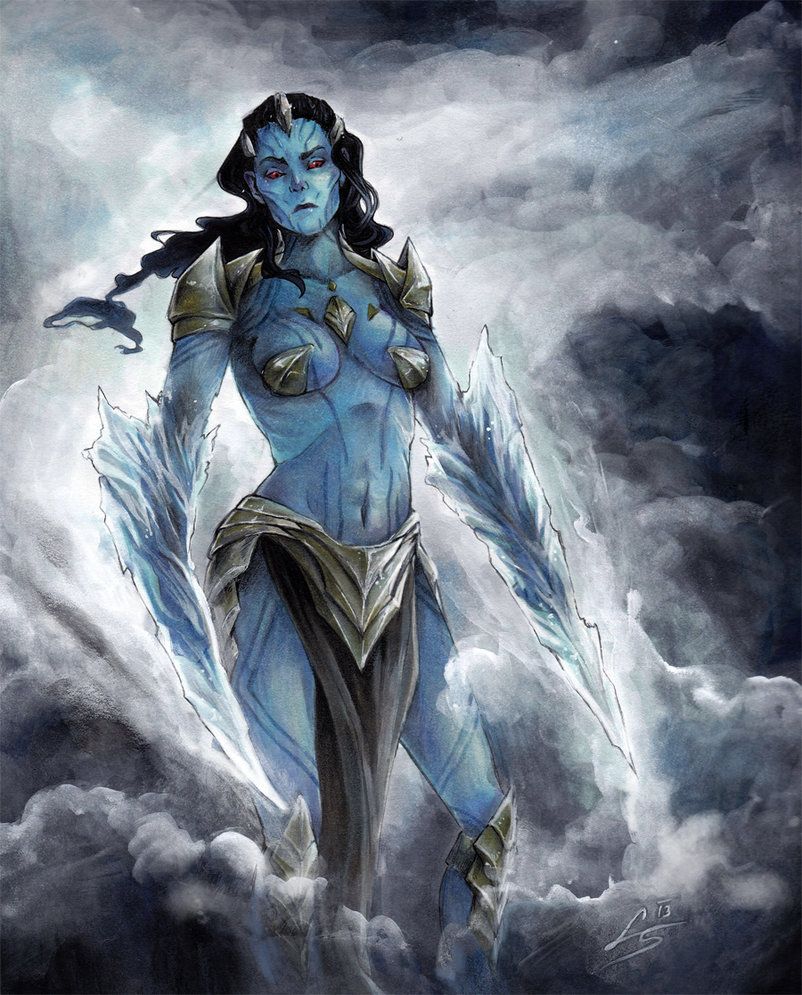
The ship form of Nal is symbolised by Naglfar, the ship of dead men's nails, in which some of the Rökkr forces travel to the battle of Ragnarok. Naglfar, as befits a Rökkr ship, is a paradoxical symbol, because although it is the ship of the dead, it is also a ship of life and rebirth. The German word for ship, schiff, which is descended from the Old Norse skop, also means fate and genitals; a sexual connection that finds modern confirmation in frigging, a nautically-themed slang word for sex. The ship as the genitals of the goddess is revealed in aerial views of Scandinavian ruins, in which what appears to be oval vesica-pisces designs stare upwards like cyclopic eyes. These are in fact, the remains of ship-shaped cemetery markers, which ensured that the dead sailed on into the next world. Similar in nature was the practice of burning funeral ships, as is remembered in the aptly named Shetland festival of Up-Hely-Aa.
Naglfar, as the ship made of dead men's nails, is the ship of Nal, whose name is cognate with nowl/nail. It symbolizes her life-creating vagina, from which flowed Loki; he affirms this descent at Ragnarok when he steers the ship towards the field of the Vigrid playroom. Ragnarok as the going into the shadow of the world is the return to the primordial womb of the goddess, the void of Ginungugap. Ginungugap, which once again symbolizes the vagina of Nal (and Angrboda and Hela), is, not surprisingly, another form of this ship, since gin/kin in Old Icelandic signifies the prow of a boat. This raft of symbols is further cemented in Loki's rune Kaunaz, which is as much his as it is his mothers. The boat symbolism can be seen in the German word Kahn (a small boat), and the Old Norse Kan (boat and cup), while when placed on its side, the rune transforms into the Old Norse kunta and the Old Frisian kunte (cunt). Loki is the fiery torch that emerges from the vagina of his mother Nal; he is her messenger who appears at the creation of the world, and again at its destruction. In everything he does, Loki states where he has come from, and prophesies that he will take the entire world with him back into the womb of his mother.
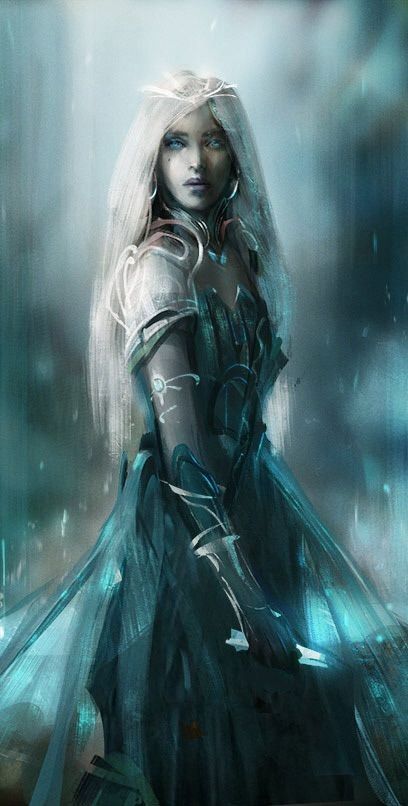
With her association with the ship of the dead, Nal can be seen as made manifest in the psychopomp Mordgud. She usually appears standing an the Gjallarbru bridge, but sometimes she offers a boat to cross Gjall: for example,.in the Cnawan-Lac working; or in Greybeard's working of 17º10º98 (see The Rökkrbok and Helvegr #1 respectively), in which the ship is made of skulls. The other instance of the psychopomp and her death ship is when Angrboda as Hyrrokin appeared at the funeral of Balder, and pushed the funeral ship Ringhorn into the world ocean, and onto Hel. This tale is significant in that it broaches an important point. We have referred in the course of this article to Angrboda-Hyrrokin as only the daughter-in-law of Nal, but it is possible that she may be her actual daughter; making Loki her brother. There is much evidence that suggests that Angrboda and Ran are really the same goddess (though they are both fully individuated), for example both are associated with the violent and stormy side of the sea, and both are married to Eggthir (another son of Nal). It may, therefore, be apt to refer to Angrboda as the daughter of Nal; her father being Hrimner, possibly another name for Ymir, or for Bergelmir.
The ship of death appears elsewhere in the world, notably in the Egyptian solar bark, and the boat on which Morgana le Fay took Arthur to Avalon. But most important of all was the ritual ship used at Delphi in Greece, which was referred to as the Umbilicis, or the Omphalos, in that it was connected to the symbology of the navel of the earth. This is apposite because Nal's cognate of nowl/nal was the name given to the celestial omphalos of the pole star. The nail was thought to hold the world axis/tree/mountain in place, and corresponded to a terrestrial omphalos at the centre of the earth in hel. Nal's other name of Laufey, with its meaning of wooded isle, refers to the idea of Nal as the axial world mountain, upon which grows the world tree; it echoes classical descriptions of the Cyclops Polyphemus as a wooded peak, and of the witch Circe's wooded axial island.

Nal is therefore the celestial omphalos of the pole star, and it is as this nowl that she appears an the Yule Tree, as either the star, or the fairy. At the same time, she is also the omphalos on earth (which is her body), and the chthonic omphalos at the centre of the earth, manifested in her grand daughter Hela. This navel imagery can then be applied to the microkozm of the human body, where the chthonic omphalos of Hela is at the base of the spine; the terrestrial omphalas appears in the navel proper, ruled by another granddaughter of Nal, Iormungand, who surrounds the world of Midgard; and the celestial amphalas appears initially in the brow, ruled by Nal's daughter in law, Angrboda, but her reality is fully experienced in the crown; represented by the chthonic dragon Nidhogg.
In Tantra, the serpentine energy of kundalini is raised up through these points (as well as those at the solar plexus, heart, and throat), and when it, albeit rarely, reaches the crown, the experience is called the Thousand Petalled Lotus. The experiencing of the Thousand-Petalled Lotus (which could be called the Thousand-Petalled Rose within a Rökkr context) is, of course, beyond any true definition, but could be said to be like a hole farming in the crown of the head, through which the void flows in, and lets the entirety of the kozmos, be experienced. Accounts state that within the crown, is the Ama-Kala (a goddess in the shape of a horn), and within the Ama-Kala is the Nirvana-Kala (a goddess in the shape of a bowl), which is "as subtle as the thousandth part of the end of a hair and of the shape of the crescent moon." Inside the Nirvana-Kala is the parabindu (the ultimate singular point), which is "the Supreme and Primordial Nirvana-Shaktil; She is lustrous like ten million suns, and is the Mother of the three worlds. She is extremely subtle, and like unto the ten-millionth part of the end of a hair. She contains within Her the constantly flowing stream of gladness, and is the life of all beings. She graciously carries the knowledge of the Truth to the mind of the sages.”
This goddess in a Rökkr context is obviously Nal, who like the Nirvana-Shakti, is thought to be extremely thin, as thin as a nowl-nail; a nail made of meteorite iron. The horn and the bowl are the Gjallarharn and the well of Hvergelmir. The singular point of the parabindu is both Nal, and the stellar home of Nal, which, while containing everything at an highly concentrated point is simultaneously, the expansive abyss of Ginungugap.
The seven Rökkr centres of energy (just like their eastern counterparts, the chakras) can be visualized in a number of ways. They can be seen as wheels, or labyrinths, of swirling energy; as roses with various numbers of petals; rings, like those in the Volsung Saga; or as glowing eyes. The later is particularly apt if we visualize these centres at the base, navel, and brow, as the eyes of Nal. The brow and the crown, corresponding to the pole star, make a particularly striking image as the eye (and the ”I”, as in consciousness) at the centre of the universe. It is from this eye of Nal that Loki descends as lightning, acting once again as the emanation of his mother. A Finnish account relates something akin to this by saying how fire had a "cradle on the navel of the sky," from where it descended through the nine skies to the bottom of the sea.
The emanations of Nal fall as fire from the centre of the sky, and manifest as meteorites. It is just such a meteorite that forms the omphalos of the underworld, where the dragon Nidhogg has a jewel on its brow; and the omphalos of Middle Earth, where meteoric stone has long been put to sacred use, and recognized as a gift from the universe. Because each of these omphali is part of the one goddess, Nal, energy flows constantly between them, and only the axis of the human body is needed to channel this force. By standing an the central omphalos that is the earth, and between the terrestrial and celestial omphali, we partake of Grandmother Nal.