






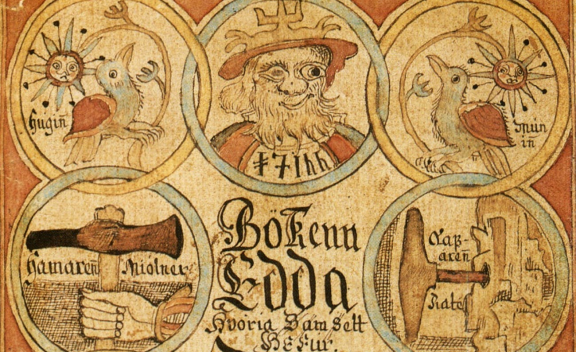
It can be confidently asserted that Scandinavian literature can trace its origins back to Old Icelandic literature. For many years, Vikings journeyed from one land to another, conquering new territories and attempting to establish settlements. However, in most cases, the cultures, languages, and traditions of the conquered peoples proved more dominant, leading to the gradual assimilation of Viking influences over time. The Vikings managed to preserve their distinctive characteristics only in regions that were unpopulated prior to their arrival. Consequently, Iceland stands out as the sole nation truly founded by Vikings.
Ari the Wise (1067-1148), the first Icelandic chronicler who authored the initial history of Iceland known as "The Book of the Icelanders," recorded that the first settlers arrived in Iceland "shortly after the year 870." Another source indicates that the first arrivals came in 874. As a result, the history of Iceland and Icelandic literature now spans over a thousand years. Old Icelandic literature can be categorized into two main groups: Edda poetry and scaldic poetry. Early Icelandic poetry was closely intertwined with paganism, with people believing that the gift of versification was bestowed by the Supreme God Odin.
The world is acquainted with tales of gods and heroes thanks to the Poetic Edda songs, which are a collection of songs included in the Codex Regius. This manuscript was discovered in Iceland in 1643 and remained in Copenhagen for a considerable period before returning to Iceland, specifically to the Arni Magnusson Institute in Reykjavik, in April 1971.
Edda poetry possesses a distinct character. Its authorship is unknown, and its form is quite simple, comprising mythological and heroic narratives and worldly wisdom. Each song is relatively short yet brimming with action, typically focusing on one episode from the lives of heroes or gods. The Poetic Edda can be divided into two sections: the first part delves into the stories of gods, while the second part focuses on heroes.
Völuspá stands out as the most renowned saga in the Poetic Edda. The first section of this saga narrates the creation of the world and its major historical events, while the second part describes the world's end and the demise of the gods. Additionally, there are Germanic-origin songs within the Poetic Edda, recounting the tales of Sigurd and Atli, often referred to as "The Song of the Nibelungs."
The Prose Edda, on the other hand, was composed by the scald Snorri Sturluson (1178-1241). It encompasses guidelines for poetry and a retelling of Norse mythology.