

Ragnarok signifies the catastrophic annihilation of the entire cosmos, including even the gods themselves. Within the framework of Norse mythology, Ragnarok is positioned as the ultimate narrative, occurring at the very end of the chronology. For the Vikings, this myth served as a prophecy, foretelling an unspecified and mysterious future event, yet it carried profound implications for their understanding of the world in their contemporary era. Below, we will delve into some of these implications.
The term "Ragnarok" finds its origins in Old Norse as "Ragnarök," meaning the "Fate of the Gods." Interestingly, some Old Norse texts also refer to it as "Ragnarøkkr," which can be translated as the "Twilight of the Gods." Periodically, this event was also alluded to as "aldar rök," signifying the "fate of mankind," among other names.
Without further delay, here is the account of Ragnarok:
The Fate of the Gods
At some point, as decreed by the enigmatic weavers of fate known as the Norns, a Great Winter (Old Norse "fimbulvetr," sometimes Anglicized as "Fimbulwinter") will descend upon the world, unlike any previous winter. Merciless winds will carry snow from all directions, and the warmth of the sun will wane, subjecting the earth to unprecedented cold. This winter shall endure for the duration of three regular winters, with no intervening summers. Humanity will become so desperate for sustenance and essential provisions that all societal laws and moral values will disintegrate, leaving behind a stark struggle for survival. It will be an era dominated by swords and axes; brother shall slay brother, father shall slay son, and sons shall slay fathers.
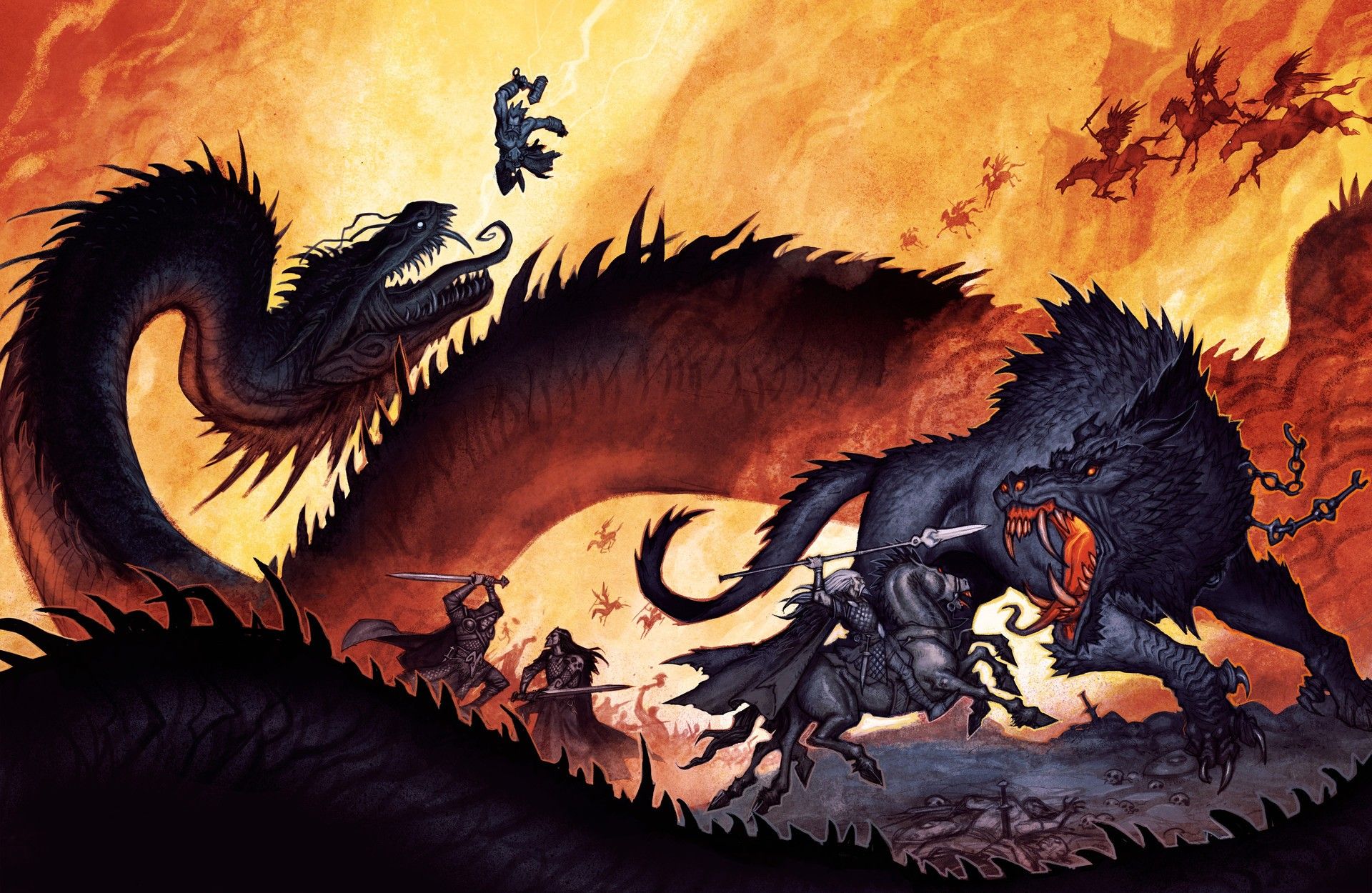
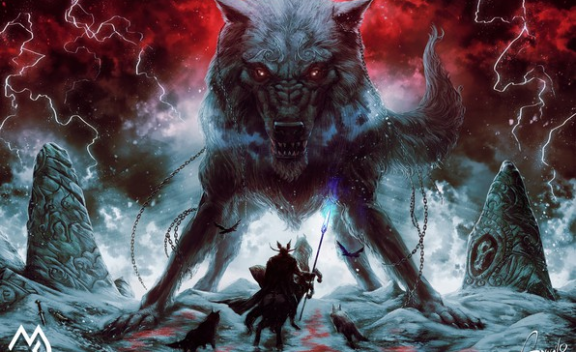
Skoll and Hati, the relentless pursuers of the sun and the moon across the heavens since time immemorial, shall at last capture their elusive prey. The stars, too, shall vanish, leaving nothing but an abyss in the celestial expanse. Yggdrasil, the colossal tree that upholds the cosmos, will shudder, causing all trees and even mountains to topple to the earth. The binding chain restraining the monstrous wolf Fenrir will snap, and the beast shall roam freely. Jormungand, the colossal serpent dwelling at the ocean's depths and encircling the land, will ascend from the abyss, unleashing the seas to inundate the entire world.
These convulsions will dislodge the ship Naglfar ("Nail Ship") from its anchorage. Constructed from the nails of deceased men and women, this vessel will sail effortlessly over the submerged earth, manned by an army of giants representing chaos and destruction. Leading them will be none other than Loki, the betrayer of the gods, who will have broken free from the chains that had bound him.
Fenrir, his eyes and nostrils ablaze with fire, will race across the earth, with his lower jaw scraping the ground and his upper jaw reaching the sky, consuming everything in his path. Jormungand will spew venom over the entire world, poisoning land, water, and air alike.
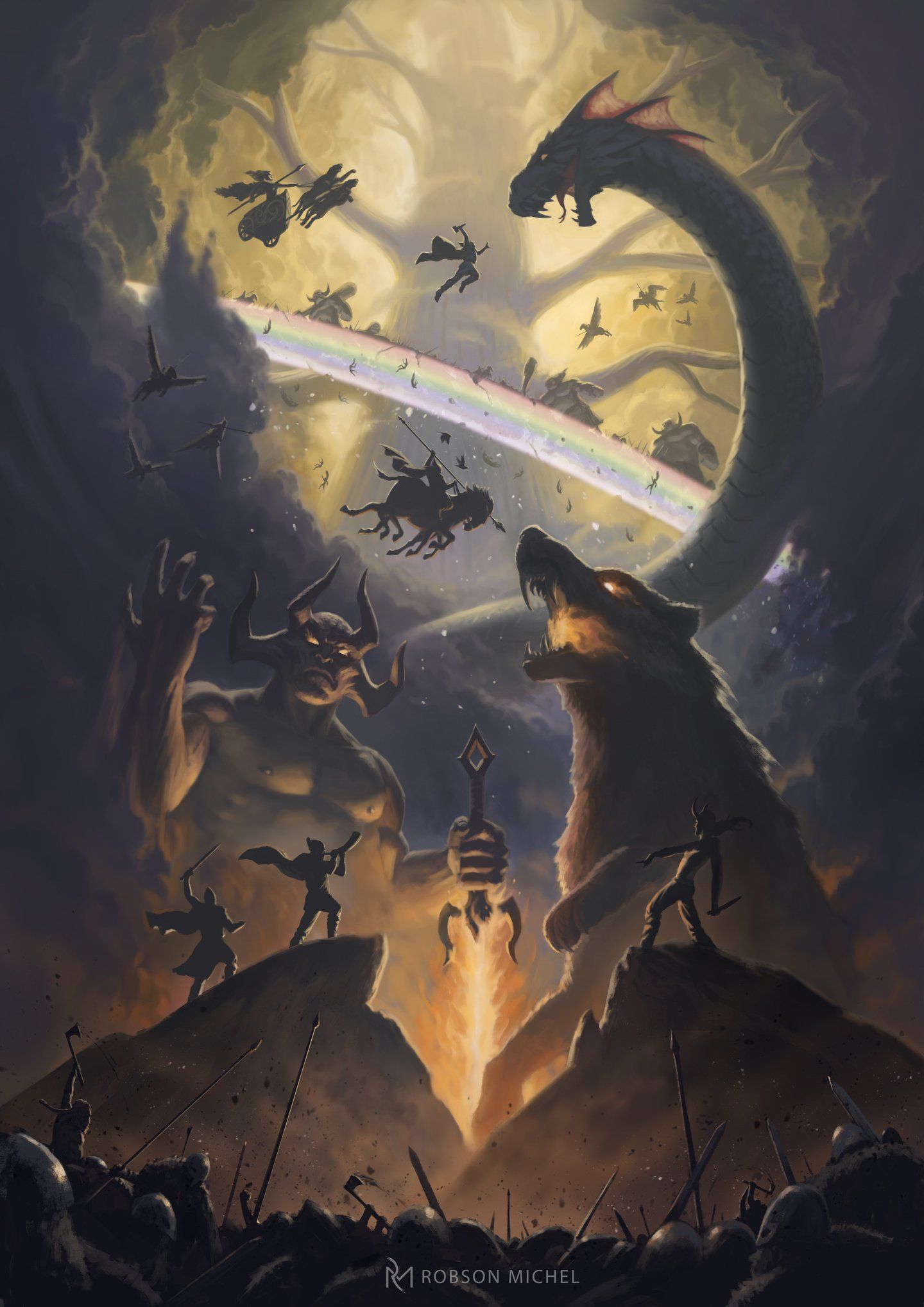
The firmament shall rupture, and from the breach will emerge the fire-giants from Muspelheim. Their commander will be Surt, wielding a fiery sword brighter than the sun. As they advance across Bifrost, the rainbow bridge to Asgard, the gods' dwelling, the bridge shall shatter and crumble behind them. A foreboding horn blast shall resound; this shall be Heimdall, the divine sentinel, sounding the Gjallarhorn to herald the arrival of the moment the gods have dreaded. Odin will seek counsel anxiously from the head of Mimir, the wisest of all beings.
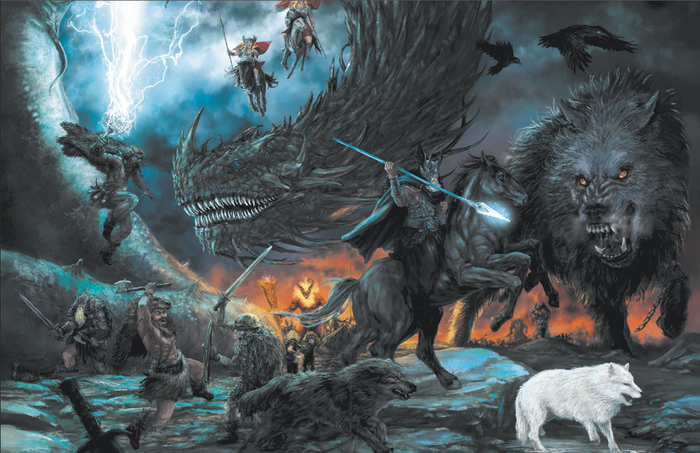
The gods will decide to go to battle, even though they know what the prophecies have foretold concerning the outcome of this clash. They will arm themselves and meet their enemies on a battlefield called Vigrid (Old Norse Vígríðr, “Plain Where Battle Surges”).
Odin will fight Fenrir, and by his side will be the einherjar, the host of his chosen human warriors whom he has kept in Valhalla for just this moment. Odin and the champions of men will fight more valiantly than anyone has ever fought before. But it will not be enough. Fenrir will swallow Odin and his men. Then one of Odin’s sons, Vidar, burning with rage, will charge the beast to avenge his father. On one of his feet will be the shoe that has been crafted for this very purpose; it has been made from all the scraps of leather that human shoemakers have ever discarded, and with it Vidar will hold open the monster’s mouth. Then he will stab his sword through the wolf’s throat, killing him.
Another wolf, Garm, and the god Tyr will slay each other. Heimdall and Loki will do the same, putting a final end to the trickster’s treachery, but costing the gods one of their best in the process. The god Freyr and the giant Surt will also be the end of each other. Thor and Jormungand, those age-old foes, will both finally have their chance to kill the other. Thor will succeed in felling the great snake with the blows of his hammer. But the serpent will have covered him in so much venom that he will not be able to stand for much longer; he will take nine paces before falling dead himself and adding his blood to the already-saturated soil of Vigrid.
Then the remains of the world will sink into the sea, and there will be nothing left but the void. Creation and all that has occurred since will be completely undone, as if it had never happened.
Some say that that is the end of the tale – and of all tales, for that matter. But others hold that a new world, green and beautiful, will arise out of the waters. Vidar and a few other gods – Vali, Baldur, Hodr, and Thor’s sons Modi and Magni – will survive the downfall of the old world, and will live joyously in the new one. A man and a woman, Lif and Lifthrasir (Old Norse Líf and Lífþrasir, “Life” and “Striving after Life”), will have hidden themselves from the cataclysm in a place called the “Wood of Hoddmimir” (Hoddmímis holt), and will now come out and populate the lush land in which they will find themselves. A new sun, the daughter of the previous one, will rise in the sky. And all of this will be presided over by a new, almighty ruler.
The Meaning of Ragnarok for the Vikings
As the above implies, two versions of the myth of Ragnarok seem to be present in the Norse sources. In one of them, Ragnarok is the final end of the cosmos, and no rebirth follows it. In the other, there is a rebirth. What are we to make of this conflict?
In my book The Viking Spirit: An Introduction to Norse Mythology and Religion, I argue that the version in which no rebirth occurs is the older, more purely pagan view, and the rebirth story is an addition that developed only late in the Viking Age under Christian influence. Ragnarok had been reinterpreted to describe the religious transformation the Viking world was undergoing, in which the old gods were indeed dying, but were also being replaced with something else. A relatively short article such as this isn’t the place to present this argument and the evidence for it as I do in the book, so if you want to see my reasoning, read the book. Half a chapter is devoted to this topic. But here’s the gist: the rebirth addition comes only from three late sources, one of which was dependent on the other two, while all previous mentions of Ragnarok speak only of the destruction, and never of any kind of rebirth.
What would such a belief have meant for the Norse?
Imagine that you’re a Viking. You live in a world that you know will one day be obliterated. The very gods themselves will perish with it. Nothing of value will be spared – not even the memory of anything that ever had value. How does such a world look to you in the present moment, given that the seeds of that final destruction have already been sown, and the world is careening inexorably toward that final decisive moment? Would this not cast a dark hue of tragedy, senselessness, and futility over the world and everything that occurs within it? Indeed, it’s hard to escape the conclusion that this was how the Vikings saw the world on one level.
Yet Ragnarok also carried another meaning for them, one which complemented yet altered this tragic view of life.
In addition to being a prophecy about the future that revealed much about the underlying nature of the world along the way, the myth of Ragnarok also served as a paradigmatic model for human action. For the Vikings, the tale didn’t produce hopelessness as much as inspiration and invigoration. Just as the gods will one day die, so too will each individual human being. And just as the gods will go out and face their fate with dignity, honor, and courage, so too can humans. In this view, the inevitability of death and misfortune should not paralyze us, but should instead spur us to hold noble attitudes and do noble deeds – the kind worthy of being recounted by bards many generations after we ourselves are gone.