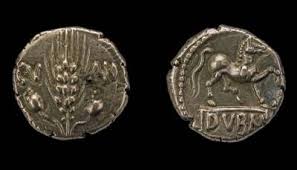


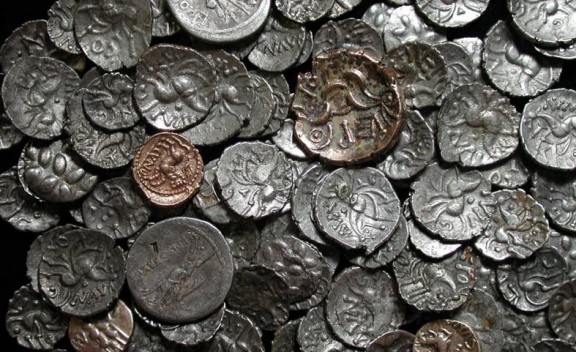
The Hallaton Treasure is a significant archaeological find discovered near Hallaton in south-east Leicestershire, England, in 2000. It is considered one of the largest and most important hoards of British Iron Age coins and artifacts, shedding light on the region's history and connections with the Roman Empire. Here are some key details about the Hallaton Treasure:
1. Discovery: The discovery of the Hallaton Treasure began with a find by metal detectorist Ken Wallace on November 19, 2000. He uncovered about 130 coins with a metal detector, prompting further investigation by local archaeologists and the University of Leicester Archaeological Services (ULAS).
2. Contents: The treasure trove includes over 5,000 silver and gold coins, a gilded silver Roman ceremonial helmet, jewelry, and other items. Most of the objects date from the time of the Roman conquest of Britain in the first century AD.
3. Coin Attribution: Of the coins found in the hoard, 4,835 can be attributed to the local tribe known as the Coryeltawy. This discovery significantly increased the total number of known Coryeltawy coins. Notably, a silver Roman coin from the hoard has been dated to 211 B.C., making it the oldest Roman coin found in Britain.
4. Historical Significance: The presence of Roman-era artifacts suggests a connection between the East Midlands region and the Roman Empire. Some archaeologists believe that these artifacts may have arrived in Britain before the Roman conquest in 43 AD, possibly through trade or diplomacy.
5. Ritual Site: The site where the treasure was discovered is believed to be a significant ritual site, particularly during the periods before and after the Roman conquest. It is considered a type of open-air sanctuary, surrounded by a moat and paling, and represents a unique archaeological find in Britain.
6. Display: Many of the Hallaton Treasure artifacts are on display at the Harborough Museum. The Roman helmet underwent extensive conservation work at the British Museum and was also displayed at the Harborough Museum in 2012.
7. Dog Sacrifice: A dog skeleton was found at the site, believed to have been sacrificed as part of a ritual to protect the treasure. The dog's remains were put on display at the Harborough Museum.
8. Celtic God Connection: In 2012, a silver ring with the inscription "TOT" was discovered at the site, possibly referring to the Celtic god Tutatis, a counterpart of the Roman god Mars. The ring was acquired by Leicestershire County Council for display at the Harborough Museum.
The Hallaton Treasure not only provides insights into the local history and culture of the region but also highlights its connections with the Roman Empire during a critical period in Britain's history.