


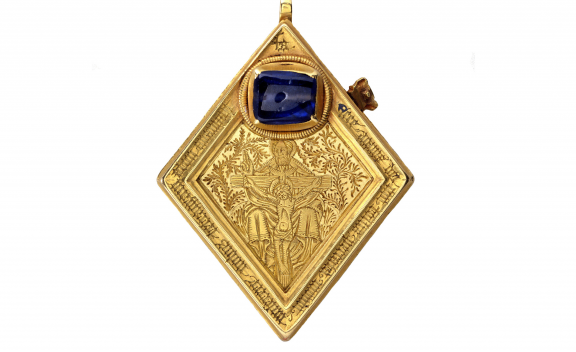
The Middleham Jewel is a remarkable late 15th-century pendant made of gold and featuring a large blue sapphire stone. It was discovered in 1985 near Middleham Castle, the northern residence of Richard III, and is now housed in the Yorkshire Museum in York. Here are some key details about the Middleham Jewel:
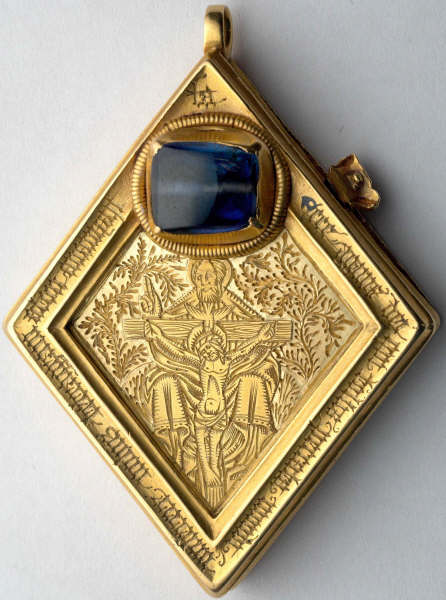
1. Description: The Middleham Jewel is a diamond-shaped gold pendant weighing approximately 68 grams (2.4 ounces). It features a prominent 10-carat blue sapphire set on one side. The pendant measures about 6.4 centimeters (2.5 inches) in diameter.
2. Engravings: Both sides of the pendant are intricately engraved with religious scenes. On the obverse side, you can find a depiction of the Trinity, which includes the Crucifixion of Jesus. Surrounding this scene is a Latin inscription that reads, "Ecce Agnus Dei qui tollis peccata mundi ... miserere nobis ... tetragramaton ... Ananyzapta." This inscription translates to "Behold the Lamb of God, who removes the sins of the world. Have mercy on us..." The final word, "Ananyzapta," may have had a protective or magical purpose against epilepsy.
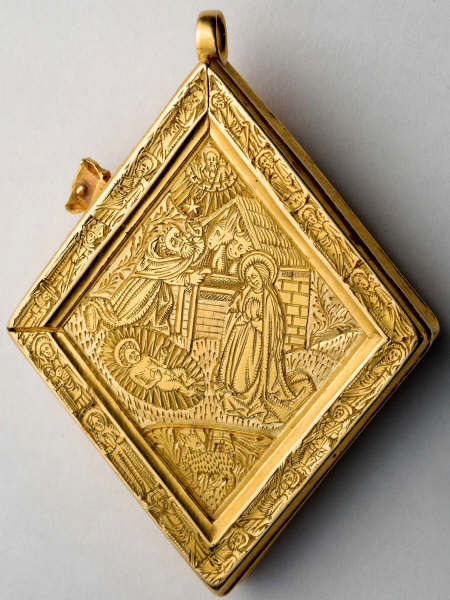
3. Reverse Side: The reverse side of the pendant features an engraved image of the Nativity with the Lamb of God. It is surrounded by the faces of fifteen saints. Some of these saints are identifiable, including Saint Peter, Saint George, Saint Barbara, Saint Margaret of Antioch, Saint Catherine of Alexandria, and Dorothea of Caesarea, among others. There are also suggestions for additional saints, such as Saint Augustine of Hippo, Saint Nicholas of Myra, Saint Jerome, Saint Anthony of Padua, Saint Agnes, Saint Cecilia, Saint Clara of Assisi, and Saint Helena or Brigitte of Sweden.
4. Reliquary Function: The Middleham Jewel is believed to have served as a reliquary. It has a hollow interior that originally contained three and a half tiny discs made of silk embroidered with gold thread. These textile fragments identified the pendant as a reliquary containing a fragment of holy cloth.
5. Symbolism and Purpose: The sapphire stone's blue color may symbolize heaven, and the pendant may have been used as a prayer aid. Its imagery, including the presence of holy women and nativity scenes, suggests that it might have been intended to aid in childbirth. Additionally, the sapphire was believed to possess healing properties, including curing ulcers, improving eyesight, alleviating headaches, and addressing stuttering. The inclusion of the Latin words "Tetragrammaton" and "Ananizapta" may have been meant to provide protection against epilepsy.
6. Ownership: The jewel is thought to have belonged to a high-status individual, possibly a relative of Richard III, such as his wife Anne Neville, his mother Cecily Neville, or his mother-in-law Anne Beauchamp. It is likely that the jewel had significant religious and personal significance to its owner.
The Middleham Jewel is a valuable historical artifact that offers insights into the religious beliefs, symbolism, and customs of the late 15th century. Its exceptional craftsmanship and detailed engravings make it a significant piece of jewelry from the period.