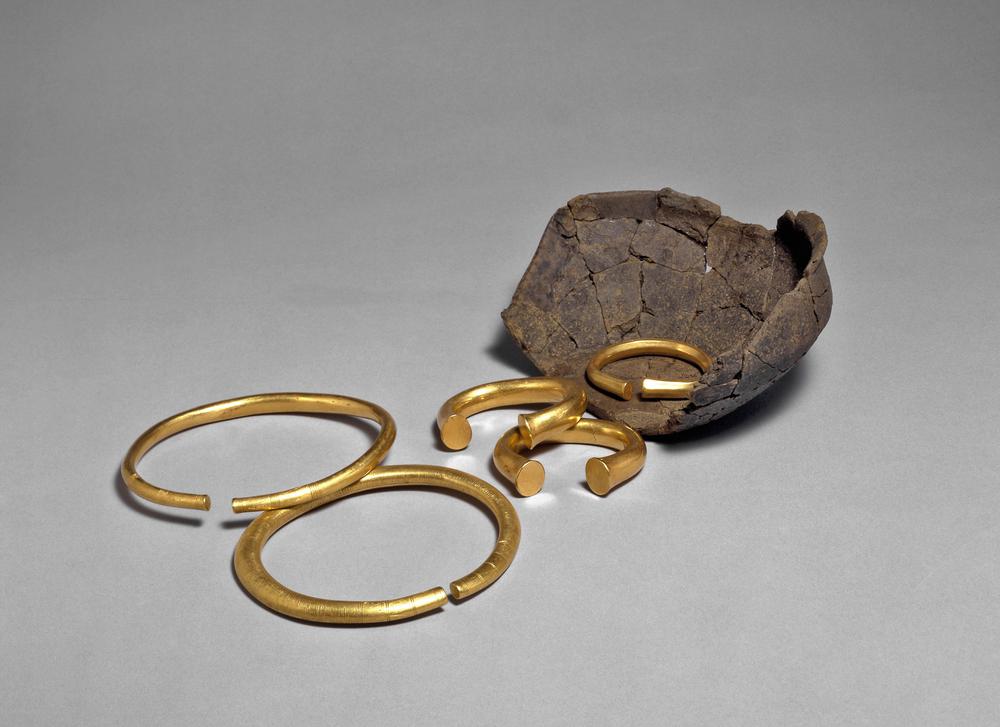


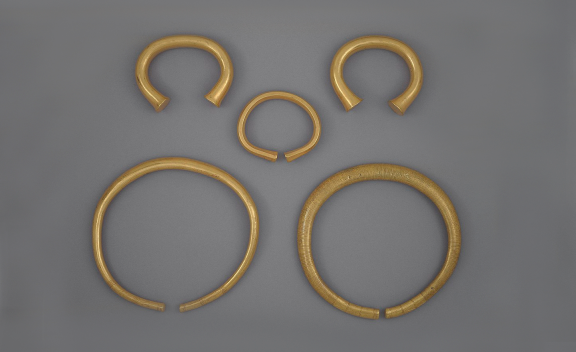
The Milton Keynes Treasure is a collection of gold and bronze artifacts that were discovered in September 2000 in a field near Monkston in Milton Keynes, England. This treasure includes two ends, three bracelets, and a fragment of a bronze rod found inside a pottery vessel. The presence of pottery in the discovery allowed experts to date it to around 1150-800 BC.
Weighing in at 2,020 kilograms (4.45 pounds), this treasure is considered by the British Museum to be "one of the most significant concentrations of Bronze Age gold ever found in Britain." It holds importance in providing insights into the social and economic aspects of that time period. The estimated value of the treasure is £290,000, and it is currently housed in the British Museum.
Interestingly, other historical artifacts, such as Romano-British hoards, have also been uncovered within a 10-12 mile radius of downtown Milton Keynes.
The discovery of the Milton Keynes Treasure was made by metal prospectors Michael Rutland and Gordon Heritage on July 7, 2000, while they were searching for metals in what is now Monxton Park. They were working in collaboration with local archaeologists, who were concluding a nearby excavation. The prospectors immediately alerted the archaeologists, a crucial step to preserve the historical context of the find. Haley Bullock of the British Museum was also commended for her prompt efforts in conserving the site and facilitating the excavation. The prospectors received a reward of 60% of the treasure's value after it was determined that claims of unauthorized searching by landowners were unfounded.
The entire treasure comprises two substantial gold ends, three smaller gold bracelets, a fragment of a bronze rod or wire, and an unadorned bowl made in the post-Deverell-Rimbury style with brown ceramic cloth, measuring 100 mm (3.9 inches) in height.
The heaviest item in the collection, weighing 626.9 grams (22.11 ounces), is item 1 according to the specifications provided. Items 2 and 4, which are the second end and bracelet, respectively, contained the highest gold content of 85% each, as confirmed by X-ray fluorescence analysis at the British Museum.
With a total weight of 2,020 kilograms (4.45 pounds), this discovery is described by the British Museum as "one of the largest accumulations of Bronze Age gold ever found in Britain and suggests a high level of wealth."
The timely reporting of the treasure's discovery by the searchers has established a connection between the gold hoard and the pottery of the British Middle and Late Bronze Age (circa 1500-800 B.C.). Furthermore, the presence of pottery in the find not only confirms its dating but also sheds light on the broader social and economic context of Bronze Age Britain, according to the British Museum.