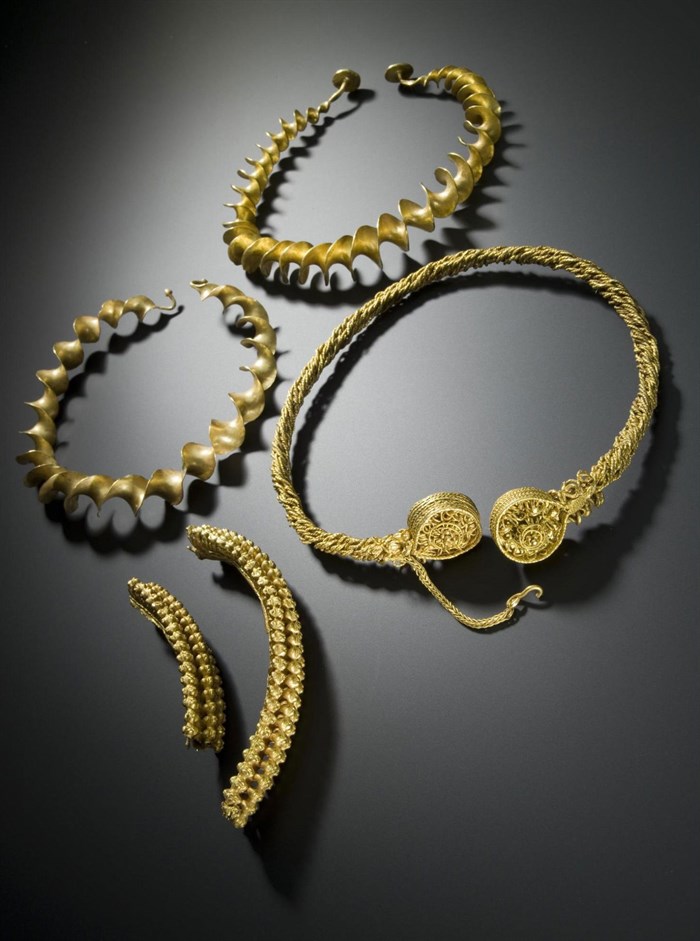


The Stirling TORCS consist of a collection of four golden Iron Age Torcs, a type of necklace, all dating back to the period between 300 and 100 B.C. These torcs were intentionally buried at some point in ancient times and were unearthed using a metal detector in a field near Blair Drummond, Sterlingshire, Scotland, on September 28, 2009. This discovery is considered the most significant find of Iron Age metalwork in Scotland and holds international importance. The torcs were appraised at £462,000 and, following a public appeal, were acquired by the National Museum of Scotland in March 2011.
All four torcs were found buried together, approximately 15-20 centimeters (6-8 inches) below the surface. Subsequent archaeological research revealed that they were originally concealed within a roundhouse, a circular prehistoric structure. This building might have had religious significance, as hoard findings usually represented offerings to deities or valuable items hidden during times of turmoil or conflict. Interestingly, the building lacked features typical of a dwelling, such as a hearth.
Despite all four torcs dating from the period between 300 and 100 B.C., they exhibit striking differences in form and style. This diversity greatly enhances the significance of the discovery. Two of them, known as the twisted ribbon torcs (numbered 1-2 in the display photo), are in excellent condition and feature an elegant and relatively simple design. They were crafted by twisting a flat strip of gold and represent a local style of jewelry with origins in both Scotland and Ireland, dating back to the Late Bronze Age. One has plain hook terminals, while the other boasts more decorative disc terminals.
The third torc is damaged, with only half of the original artifact preserved in two fragments. It is a tubular ring torc, which would have had a hinge and a fastener. In comparison to the ribbon torcs, it displays a more refined design and has been identified as a type originating from the Toulouse region in southern France. This is the first of its kind found in Great Britain.
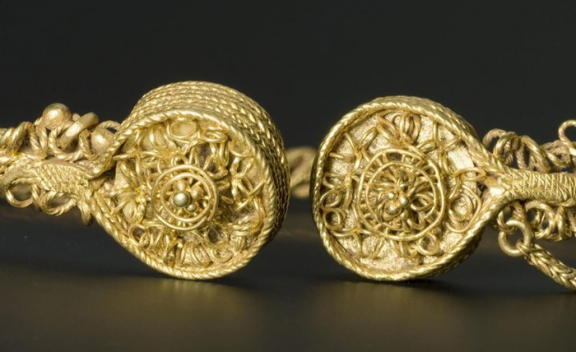
The fourth torc is a loop end torc, fully assembled and in good condition. It is constructed from eight gold wires twisted together, featuring intricately decorated terminals and a short safety clasp. Dr. Fraser Hunter, curator of the Iron Age and Romans at the National Museum of Scotland, described it as a remarkable blend of Mediterranean craftsmanship and traditional Iron Age motifs. It may have been crafted for a local chieftain by an artisan who had acquired their skills in the Mediterranean region, suggesting significant connections between Scotland and southern Europe. There are no other artifacts directly comparable to this one. The last noteworthy discovery of torcs in Scotland dates back to 1857 when gold ribbon torcs were found at Loe Farm in Moray. The eclectic mix of styles and origins parallels the diversity of items found in the Breuther Hoard in Northern Ireland, likely from a slightly later period.