



The Trinity Warehouse is a collection of Bronze Age artifacts, primarily consisting of 23 bronze axes, which were discovered in Jersey City in 2012.
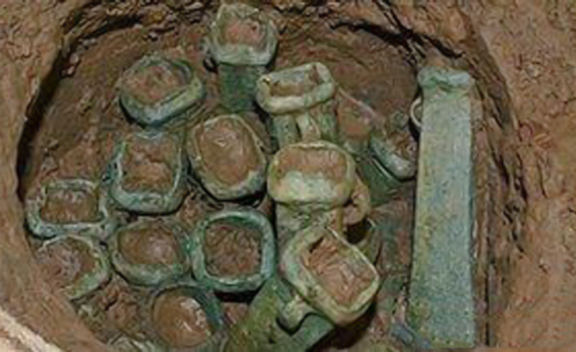
This valuable assortment of objects dating from the Late Bronze Age (circa 1000 BC) was found in October 2012 by a metal detectorist named Ken Reeve in Trinity Parish, located in the northern part of Jersey. The items were concealed within a clay container buried about 30 cm beneath the ground. Jersey Heritage's conservator was present at the site during the initial discovery before excavation commenced. The container had a diameter of approximately 30 cm, similar in size to a soccer ball. The container appeared to be damaged, possibly by a plow, which caused two of the axes to become exposed. Other materials were also found at the site, including fragments of pottery unrelated to the main discovery.
Initially, only two axes were visible protruding from the container, but further examination using X-ray scanning at the Jersey airport revealed the presence of at least 21 axes within the pot. The first two axes underwent X-ray fluorescence scanning at Cranfield University, revealing an exceptionally high lead content in the bronze alloy, almost 55%. This high lead content would have made the axes too soft for practical use, suggesting that they were likely prestigious objects collected as a symbol of wealth and status. Conservators opened an earthenware container, leading to the retrieval of a total of 25 axes, which were then entrusted to the care of Jersey Heritage and treated according to the recommendations of the British Museum. An exhibit featuring items from this hoard was subsequently displayed at the Jersey Museum in December 2012.
The discovery of the Trinity Warehouse came shortly after another significant find in Jersey, known as the Grouville Hoard, which included approximately 70,000 Celtic coins along with gold and silver jewelry.
