



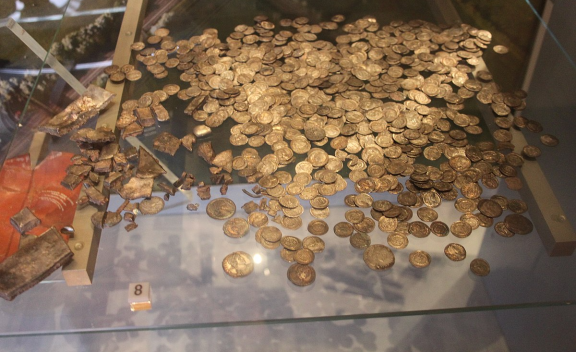
The West Bagborough Treasure is a notable collection of ancient artifacts consisting of 670 Roman coins and 72 pieces of hacksilver. These treasures were unearthed in October 2001 by a metal detector enthusiast named James Hawkesworth near West Bagborough in Somerset, England.
James Hawkesworth, who was a police officer residing in Bishops Lydard, was the individual credited with discovering this treasure. Interestingly, no traces of buildings or any other structures were found in the vicinity where the discovery took place.
After a thorough investigation into the treasure in Taunton, it was officially designated as a treasure and assigned a value of £40,650. Somerset County Museum Services acquired the treasure with the support of Somerset County Council, the Heritage Foundation Lottery, and a contribution of £16,400 from the Victoria and Albert Museum's Grant Purchase Resource Fund. Today, these remarkable artifacts are on display at the Somerset Museum, situated within the grounds of Tonton Castle.
The collection consists of 681 coins, which includes two denarii dating back to the early 2nd century, eight miliarities, and 671 pods, all originating from the period between 337 AD and 367 AD. Among these coins, a substantial number take the form of spears, with some made of silver and others crafted from copper alloy with plated silver leaf. Recent coin findings suggest that the hoard was buried around the year 365 AD. The majority of these coins were minted during the reigns of emperors Constantius II and Julian and were sourced from various mints, including those in Arles and Lyon in France, Trier in Germany, and Rome.
Additionally, there were 64 pieces of hacksilver, weighing a total of 722 grams, included in this valuable treasure.