



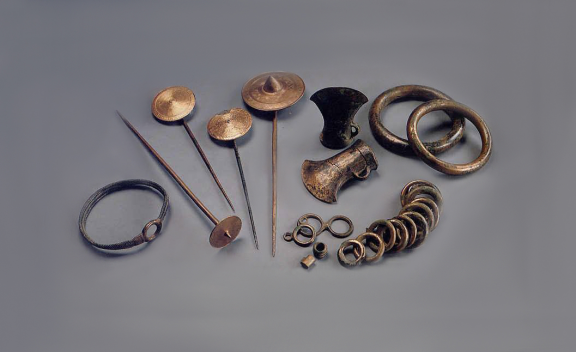
In January 1967, during sand mining operations on Mr. Joseph's land in Smith Ridge, Ballytegan, Port Laois, Laois County, Ireland, a remarkable group of bronze objects was discovered. These objects were of individual interest, but their significance was heightened due to their association in a closed find. The discovery site was located near the top of a sand and gravel ridge known as Noxie, which stood at an elevation of 300 feet above sea level. This ridge was an exception to the esker commonly referred to as the "Mary District Ridge."
The collection of objects was found approximately 18 inches below the surface in a small pit measuring about 1 foot in diameter and 6 inches in depth. This pit had been excavated from the sand and subsequently filled. According to Mr. Smith, who made the discovery, it appeared to have been filled with a substance resembling pottery clay. All of the objects described below were found by Mr. Smith within this pit.
It was suspected that some additional objects may have fallen from the wall of the sand pit when the treasure was initially discovered. However, despite efforts, Mr. Smith could not locate any other materials. Consequently, it was concluded that what Mr. Smith handed over to the National Museum constituted a complete treasure trove. The initial discovery consisted of three large rings arranged flat at the bottom of the pit, with pins and bronze axes located nearby.