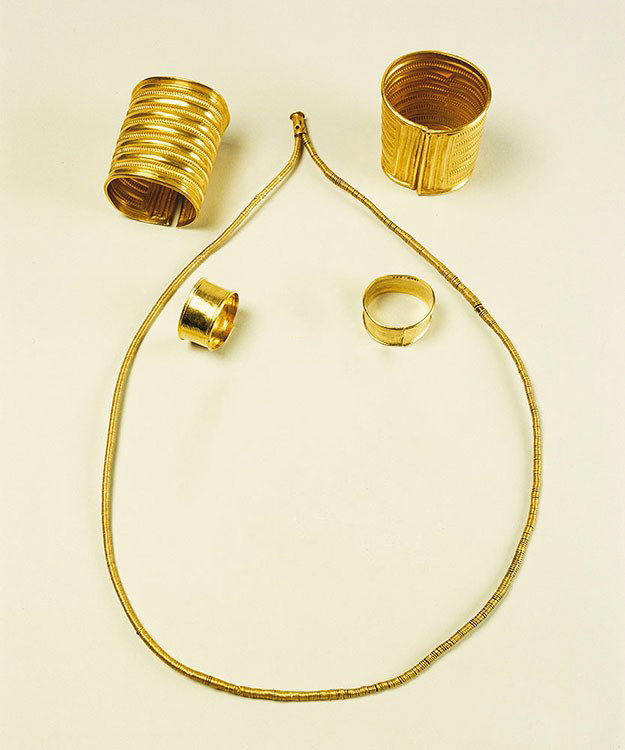


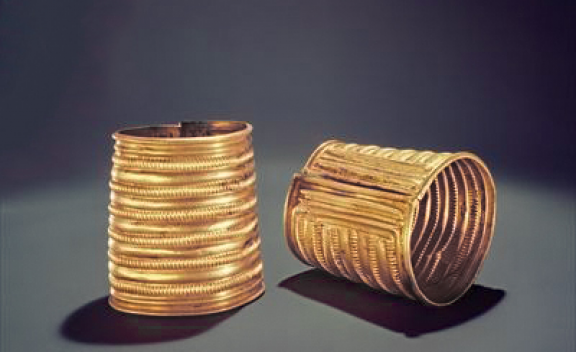
The Derrinboy wristbands are a pair of magnificent gold bracelets that have a rich history dating back to the Late Bronze Age. These precious artifacts were discovered deep within the Offaly County Swamp in 1959, as part of a small hoard of objects found by Mr. Patrick McGovern while he was digging the sod. The sod layer, situated approximately 4 meters below the swamp's surface, yielded not only the two gold wristbands but also two gold rings and a unique necklace crafted from gold and leather. These golden treasures had been preserved in the peat for more than 3,000 years.
Among the hoard's most striking pieces were undoubtedly the gold armbands. These armbands were created using gold leaf and were exquisitely adorned with intricate sculptures and perforated motifs.
The Derrinboy treasure is significant because it marks the introduction of a new artistic style in Ireland, influenced by regions spanning from Central Europe to France. This innovative style quickly gained popularity, resulting in a complete transformation of the region's jewelry and ornamentation. While the exact date of the transition from the earlier cup people with their linear geometric leaf designs to this new style remains uncertain, it is believed to have occurred sometime between 1400 and 1200 BC (uncalibrated). The precise mechanism through which this shift in fashion occurred is still a subject of study, but the transition serves as a clear demarcation between the Early and Late Bronze Age periods in the British Isles. Interestingly, areas that had previously concentrated on ornamentation during the earlier period continued to be focal points for similar concentrations during the later period, suggesting that the population remained relatively stable despite the shift in artistic style.