

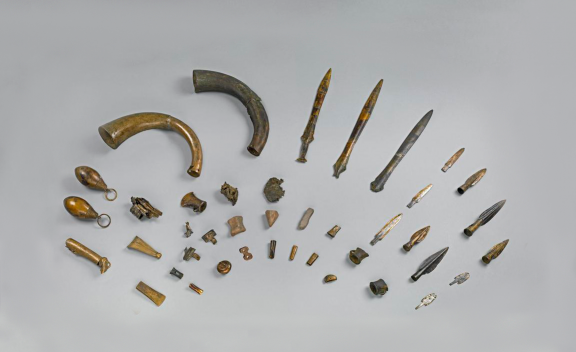
The Dowris Treasure is a significant Bronze Age hoard consisting of over 200 objects that were discovered in Dowris, Offaly, Ireland. These objects are now divided between two prestigious institutions: The National Museum of Ireland in Dublin and the British Museum in London.
This treasure trove primarily comprises bronze objects and is believed to have served as a ritual repository, possibly for religious purposes. Unfortunately, due to the limited records of its discovery by agricultural workers in the 1820s, it is challenging to determine whether it was a single deposit or a series of deposits made over an extended period. Modern interpretations lean towards it being a series of ritual deposits in the lake area.
The significance of this hoard in the context of Irish prehistory has led to the designation of the final phase of the Irish Late Bronze Age (circa 900-600 B.C.) as the Dowris phase or period. During this phase, Irish prehistoric bronze craftsmen excelled in casting and sheet metal work, representing the pinnacle of their metallurgical skills and the growth of metalworking as an industry. While ironworking had already appeared in Europe during the Hallstatt "C" culture, it had not yet reached Ireland. Throughout the Dowris phase, exceptional gold jewelry, as well as weapons, tools, pipes, and various other bronze objects, were crafted.
The Dowris treasure was serendipitously discovered in the 1820s by two individuals who were digging trenches for potato cultivation in a peat bog near the shores of Loch Coeur Lake. In the Bronze Age, this area was covered by a shallow lake, which later silted up during the late Middle Ages. Dowris is situated near the village of Wigsborough, northeast of Birr in County Offaly, Ireland. The collection eventually passed into the possession of William Parsons, 3rd Earl of Rosse, and T. D. Cooke. The latter sold his collection of Irish antiquities to the British Museum in 1854.
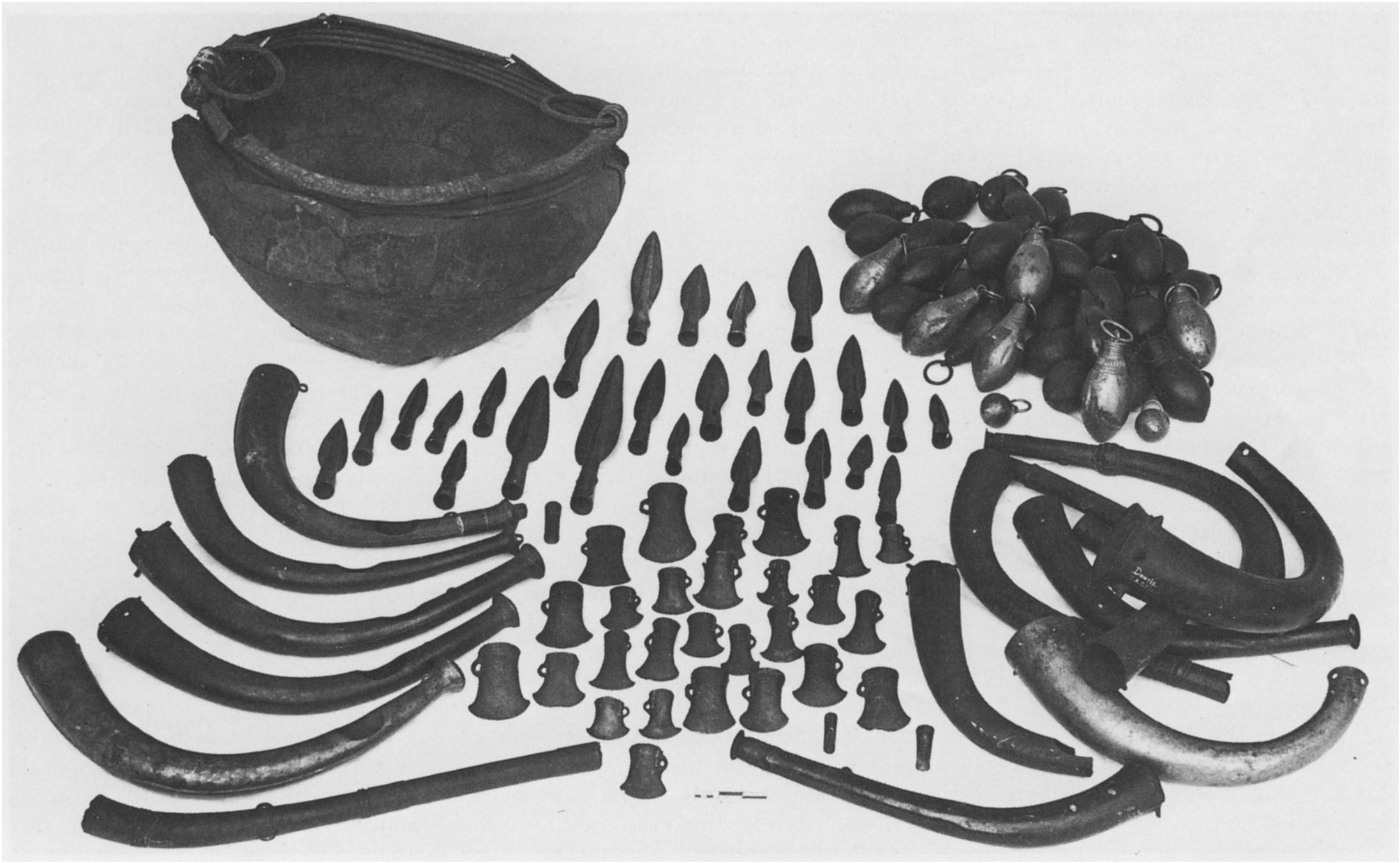
Comprising one of the largest collections of Bronze Age artifacts ever discovered in Ireland, the Dowris hoard originally consisted of more than 200 items. Presently, 111 of these objects are held in the collections of the National Museum of Ireland, while 79 are housed in the British Museum. The hoard includes:
- 44 spearheads.
- 48 crotals (musical instruments resembling rattles).
- 43 sleeve axes.
- 26 bronze horns or pipes.
- 5 swords (approximately 48 cm long, possibly originating from the south of England).
- A riveted bronze cauldron.
- Three buckets or containers.
- Numerous tools, including chisels and knives.
Notably, the treasure contains almost all known Bronze Age crotals (resembling castanets or rattles), with the other two known crotals of Irish origin. These objects are believed to have been used as rattles, possibly in fertility cult rituals associated with the bull, with echoes of such practices possibly preserved in the early medieval tale of "The Cattle Raid of Cooley" or "The Táin Bó Cúailnge." In total, there were 48 crotals in two different sizes found in the hoard.