



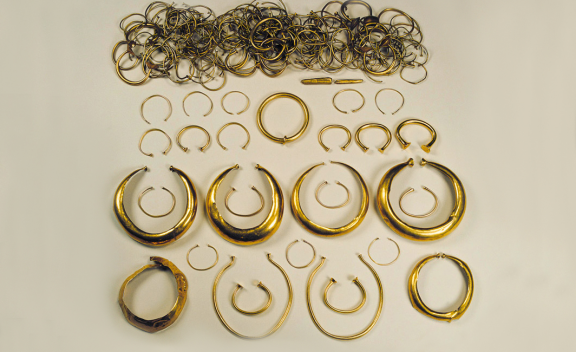
The Mooghaun North Hoard, also known as Find Great Clare, is a significant Bronze Age hoard discovered at Mooghaun North, near Newmarket-on-Fergus in County Clare, Ireland. Regarded as one of the most remarkable collections of Bronze Age gold ever found north of the Alps, much of the hoard sadly met its demise as it was melted down shortly after its discovery. Today, what remains of the hoard is divided between the National Museum of Ireland in Dublin and the British Museum in London.
In March 1854, laborers working on the construction of the West Clare Railway near Newmarket-on-Fergus stumbled upon this substantial cache of gold bronze jewelry while working on a causeway near Mooghaun Lake. During their work, they moved a rock and uncovered a large underground chamber where the treasure was hidden. Unfortunately, the majority of these precious items were sold to local dealers who melted them down for their intrinsic gold value. Only 29 items out of the more than 150 originally found have survived to this day. A significant portion of the items now held by the British Museum was acquired from William Willoughby Cole, the 3rd Earl of Enniskillen, in 1857.
At the time of its discovery, the Mooghaun North Hoard was one of the largest collections of Bronze Age treasures ever unearthed in Northern or Western Europe. It included over 150 gold objects, comprising 138 bracelets, six collars, two end pieces, and several other items, with a total weight of more than 5 kilograms. Only 29 objects, distributed between the National Museum (15 items) and the British Museum (14 items), survived the melting process. The surviving jewelry from the hoard primarily consists of crescent-shaped bracelets (23) and hexagonal collars. Fortunately, many pieces from the hoard were copied before being destroyed. Archaeologists remain uncertain about the reasons behind the hoard's placement in the stone chamber; possibilities include preservation during local crises or offerings made to the gods by vow.