



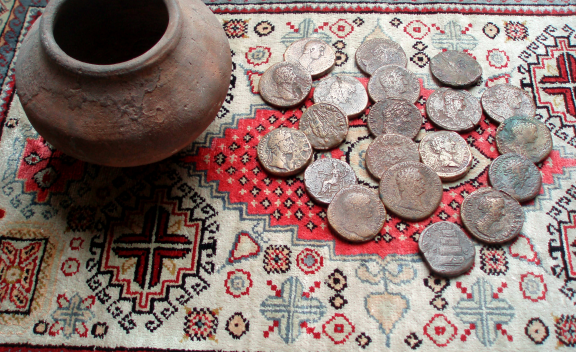
The Upchurch Treasure is a hoard of Roman sesterces that was discovered near the village of Upchurch in Kent, England, in 1950. This hoard consists of thirty-seven Roman sestercii coins, which date from the late 1st century to the second half of the 2nd century AD.
The coins in the Upchurch hoard are notable for their worn condition, indicating extensive use over a long period. Among the coins, the most recent ones, from the reigns of Divine Aurelius and Faustina II, are in relatively good condition. In contrast, the coins from the reigns of Domitian and Trajan show signs of wear and corrosion. This wear pattern suggests that the coins were in circulation for an extended period before being hidden.
The hoard was discovered in an area known as the Slay Hill Saltings or Swamps northwest of Upchurch. The coins were found in a hollow Olla, a type of pottery vessel common in the region. Based on the condition of the coins and the type of pot used, it is believed that the hoard was hidden sometime in the early third century.
Unfortunately, seventeen of the original thirty-seven coins are now missing. The remaining twenty coins include examples from various Roman emperors, such as Domitian, Trajan, Hadrian, Antoninus Pius, Elder Faustina, Marcus Aurelius, God Aurelius, and Faustina II, all of which are sesterces. The discovery of this hoard provides valuable insights into the circulation and use of Roman coinage in the region during the Roman period.