



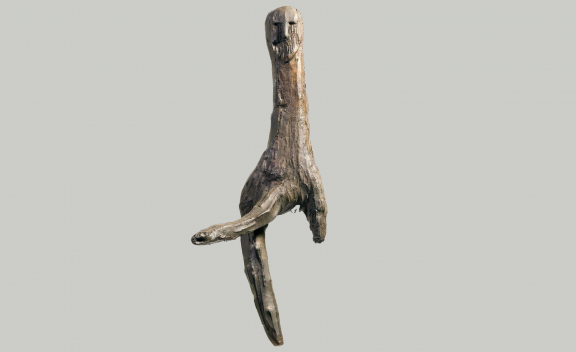
The Broddenbjerg idol is a wooden phallic figurine that was unearthed in a swamp near Broddenbjerg, close to Viborg, Denmark. It is currently housed in the National Museum of Denmark in Copenhagen and is estimated to date back to around 535-520 BC, during the Late Bronze Age.
The discovery of this figurine took place in the spring of 1880 when a man was cutting peat in the bog. Initially, it was mistakenly dated to a later period, the Roman Iron Age, but carbon dating later confirmed its true origin in the Late Bronze Age, making it the oldest known figurine of its kind in Denmark.
The figurine is crafted from an oak branch, likely chosen for its natural shape. It stands approximately 88 cm (35 inches) tall and lacks arms. Instead, it features two legs formed by the natural branches of the wood. The most striking feature is an erect penis, measuring about 28 cm (11 inches) in length, with notches carved on its head. One leg is broken off, while the other tapers, indicating that the figure was likely positioned upright in the swampy ground. At the top, there is a carved face with a pointed chin, possibly indicating a beard. This facial asymmetry is seen as a characteristic of Celtic culture, and the right eye is more extensively marked than the left, with only a line remaining for the latter. A line beneath the face may represent a neck ring or the upper part of a garment. The groin area and phallus have been treated with tar.
The Broddenbjerg idol is one of the most renowned images from Denmark, part of a collection of presumed cult images found primarily in bogs and peat bogs across Northern and Central Europe. Next to the figurine, an altar was discovered, along with corn grinding stones and clay vessels that might have contained offerings of food.