



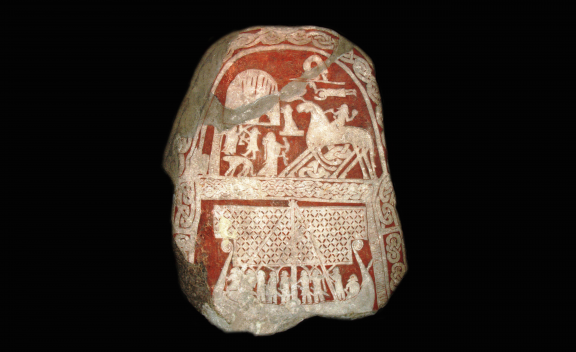
The Tjängvide stone is a significant archaeological artifact located approximately three kilometers west of Ljägarn on the island of Gotland, Sweden. The stone is a flat slab of limestone measuring 1.7 meters in height, 1.2 meters in width, and 0.3 meters in thickness. It was discovered in 1844 on the Tängvide farm and is currently housed in the Swedish National Antiquities Museum in Stockholm. The stone is believed to have pagan origins, as there are no evident Christian elements in its inscription.
The Tjängvide stone is adorned with various figures in both its upper and lower sections, separated by a woven pattern resembling a walnut. In the upper field, there is a prominent depiction of a large eight-legged horse with a small rider. A woman in this scene is shown offering a horn to the rider, and there are other less discernible figures as well.
The rider on the eight-legged horse is commonly identified as Odin, riding his legendary steed Sleipnir, or as a deceased individual arriving at Valhalla on Odin's horse. The female figure is often interpreted as a Valkyrie, a mythological being associated with selecting the slain for Valhalla.
Alternative interpretations of the images exist as well. According to one interpretation, based on the Volsung saga, the rider is Sigurd, who rides a horse named the Border (a descendant of Sleipnir), and the welcoming woman could be either Brunhild or Grimhild, greeting Sigurd upon his arrival at the court of the Gyukungs. This story was popular during the Viking Age and is depicted on other runic stones and image stones known as Sigurd's stones. It's also possible that the eight legs symbolize the horse's swiftness, and the rider might be a living man welcomed by his wife. The man standing behind the woman appears to hold a bow, possibly representing a deceased individual hunting, while the four-legged figure may represent a hunting dog.
The lower part of the stone is dominated by an image of a longship with a high stern and prow. The sail is notably wide, almost equal in length to the ship itself.
It's worth noting that the Tjängvide stone has a phallic shape, and similar combinations of death-related and erotic symbolism can be found on other runic stones and image stones from Gotland, providing intriguing insights into the complex cultural and symbolic aspects of the time.