



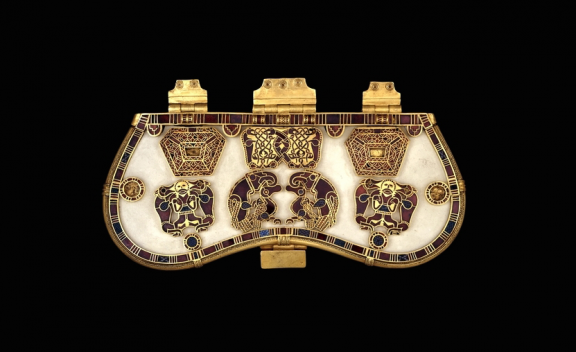
The public display of wealth and its role in establishing status in early Anglo-Saxon society appears to have parallels with contemporary practices. Among the artifacts from this era, the wallet cover discovered at Sutton Hoo stands out as one of the most opulent ever found.
The wallet cover was designed to encase a leather pouch containing gold coins and was attached to a belt through three loops. It was secured with a gold buckle. Although the lid is now heavily damaged, it is believed to have been crafted from whalebone, a highly prized material in early Anglo-Saxon England. Embedded within it are seven ornate gold plaques featuring cloisonné garnets and glass millefiori, which is a type of glasswork. These materials, both the large and small garnets, were carefully combined to emphasize the intricate details of the images on the lid. It is possible that this combination of materials and craftsmanship suggests a single artisan's workshop, potentially responsible for creating not only the wallet cover but also the other gold and garnet jewelry found in the same burial site (Kurgan 1), possibly as a unified set.
The lid of the wallet cover features double images of a bird of prey attacking a bird resembling a duck, as well as a man standing heroically between the two creatures. While these images clearly held significance for the Anglo-Saxons, their exact interpretation remains elusive. These fierce creatures likely symbolized qualities such as strength and courage, attributes essential for a successful leader or ruler. Notably, similar depictions of a man positioned between animals have been found in Scandinavian contexts, indicating potential cultural connections and shared symbolism across regions during that time.