



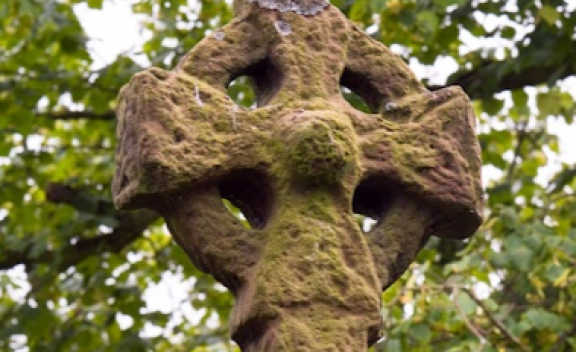
The Gosforth Cross is a notable Anglo-Saxon stone cross located in the churchyard of St. Mary's in Gosforth, Cumbria, England. Dating back to the first half of the 10th century AD, this cross holds significance for its unique combination of Christian and Nordic symbols, reflecting the influence of Christianization on Scandinavia.
Key features and interpretations of the Gosforth Cross include:
1. **Origin and Settlement**: The area around Gosforth was settled by Scandinavians, possibly in the 9th or 10th century, following the Kingdom of Northumbria.
2. **Design and Carvings**: The cross is elaborately carved and incorporates Christian symbols along with scenes and characters from Norse mythology, similar to how the Jelling stones in Denmark depict Jesus alongside Norse mythological figures. The cross design itself follows a Christian pattern that originated during the Christianization of Ireland.
3. **Identified Images**: The carvings on the Gosforth Cross have been interpreted to represent various scenes from Norse mythology, including:
- Loki bound with his wife Sigyn protecting him.
- The god Heimdallr holding his horn.
- The god Víðarr tearing the jaws of Fenrir.
- Thor's unsuccessful attempt to catch Jörmungandr, the Midgard Serpent.
4. **Parallel Themes**: Scholars debate whether these Norse mythological scenes were added to the cross to either maintain a connection to Viking beliefs while adopting Christianity or to draw parallels between Norse and Christian narratives. For instance, Loki's binding is seen as analogous to Satan's binding, and events like Baldr's death are likened to Christ's crucifixion.
5. **Christian Symbolism**: The cross also incorporates Christian symbolism, including a depiction of the crucifixion of Christ. Christ is depicted as a powerful deity, which aligns with Viking perceptions of divine power.
6. **Design and Material**: The cross is made of red sandstone and stands at 4.4 meters (14 feet) tall. It is estimated to date from 920-950 AD and is still relatively well-preserved. Its design reflects an Anglo-Saxon influence, suggesting that the carvers were strongly influenced by Anglo-Saxon stone carving techniques.
7. **Replicas**: Due to its historical importance, replicas of the Gosforth Cross were created. Some are on display at the Victoria and Albert Museum, while a life-sized copy was commissioned by the Rev. William Slater Calverley and erected in Aspatria, Cumbria.
8. **Additional Artifacts**: The church in Gosforth also contains other significant historical artifacts, including hogback tombs and a fragment that appears to depict the Norse god Thor fishing.
The Gosforth Cross serves as a tangible representation of the blending of Christian and Norse pagan symbols and narratives during a transitional period in Scandinavian history. It highlights the cultural and religious complexities of the time and the interplay between different belief systems.