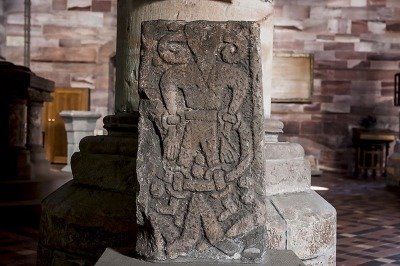


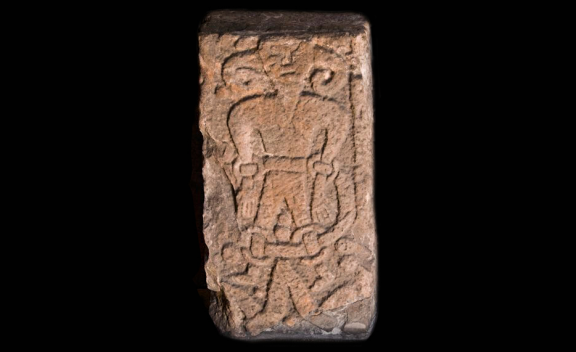
The Loki Stone is a remarkable 8th-century carved image of the Norse god Loki, depicted in a bound and chained form. It is one of only two known carved figures of this type in Europe and the sole one in Britain. The presence of the Loki Stone in Kirkby Stephen serves as a reminder of Norse influence in the region before the Norman invasion in 1066.
The original location of the Loki Stone remains unknown as it has been moved several times over the centuries. For an extended period, it was situated among a collection of old tombstones outside the eastern part of St. Stephen's Church, exposed to the elements. Thankfully, it has now found a permanent home inside the church, positioned directly across from the south door, welcoming visitors as they enter.
The stone stands at about 1 meter in height and has a rectangular shape. Dating estimates for the stone have varied, ranging from the 8th to the 10th centuries. However, the most commonly accepted dating places it in the 8th century. An intriguing aspect of the carving is that it extends onto the top of the stone. In other words, while the figure of Loki is on the surface facing the viewer, the carving continues onto the top of the stone, as if the vertical surface wasn't sufficient to convey everything the sculptor intended. The sides of the stone feature a simple interwoven geometric pattern.
Loki Laufeyarson is a prominent figure in Norse mythology, known as a trickster, joker, and sometimes a villain. He is the son of the giants Farbauti and Laufey. Loki's mischievous actions led to the accidental death of Baldr, Odin's second son, for which Loki was bound and imprisoned underground. In this context, Loki can be seen as a rough Norse equivalent of Christian Satan or Egyptian Seth. However, unlike Satan, Loki is not inherently evil but rather a master of deceit and deception, known for playing tricks on the gods. He possessed the ability to change shape, taking the form of birds, fish, insects, or any man or woman. This shapeshifting made him unpredictable, and his schemes often had unintended consequences.
One of the most famous stories involving Loki is the death of Baldr. Loki crafted a dart from mistletoe, the only plant that hadn't sworn not to harm Baldr. He tricked Baldr's blind brother, Höðr, into using the dart to kill Baldr. In response, the gods killed Loki's son, Narfi, and used Narfi's entrails to bind Loki to three large stones. Above him, they placed a venomous snake whose poison would drip onto his head.