



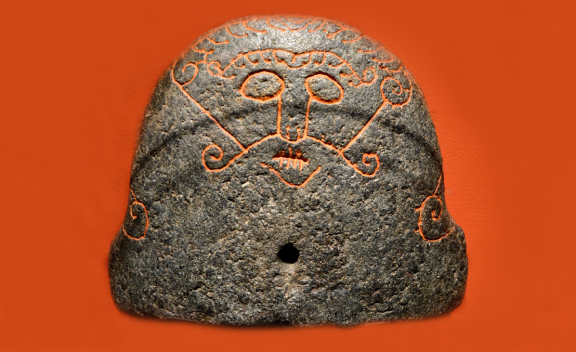
The Snaptun Stone is a significant historical artifact that features a rare depiction of Loki, the Norse trickster god. This stone, discovered on the western border between Norway and Sweden, was carved around the year 1000 AD. It portrays Loki with his lips pressed together, a detail that likely refers to a specific story from chapter 25 of the Prose Edda, a collection of Norse mythology and legends.
In this story, Loki engages in a wager with the dwarf Brock and agrees that if he loses, Brock can have his head. As fate would have it, Loki loses the bet, and Brock, along with the other dwarves, comes to claim what was promised. True to his character, Loki is not shy about giving up his head but cleverly adds that the dwarves cannot have any part of his neck. This statement sparks a debate about which part of the head is the "head," which part is the "neck," and what falls in between. Unable to reach a unanimous agreement, Brock allows Loki to keep his head (and neck). However, as punishment for evading payment through clever wordplay, Brock sews Loki's lips together.
This tale gave rise to a fallacy known as the "Loki wager," which is the erroneous claim that if a concept cannot be precisely defined, it cannot be discussed. The fallacy is countered by establishing a reasonable working definition of the concept in question.
The Snaptun Stone, bearing this depiction of Loki, is currently displayed in the "vǫlva cottage" as part of the permanent exhibition on the Viking Age at the Møsgård Museum in Denmark. It serves as an intriguing and artistic representation of a specific episode from Norse mythology, showcasing Loki's cunning nature and the consequences of his clever wordplay.