

On August 6th, 1903, a farmer by the name of Oskar Rom unearthed a mound located on his property at the Lille Oseberg farm in Slagen, within the county of Vestfold, Norway. In this mound, he made an intriguing discovery that appeared to be remnants of a ship. Following this discovery, he promptly contacted Professor Gabriel Gustafson in Oslo, who made a visit to the farm just two days later. After conducting an initial examination, Gustafson concluded that the mound contained a ship burial from the Viking era. However, he decided to postpone the excavation until the following summer. Subsequently, the excavation revealed the remains of two women who had been interred in a ship no later than the autumn of 834 AD. They were accompanied by a ceremonial wagon, four intricately designed sleds, a wide assortment of household items, and several domestic animals. What stood out was the lavish collection of textiles that adorned the burial site, making it a significant aspect of the Oseberg find.
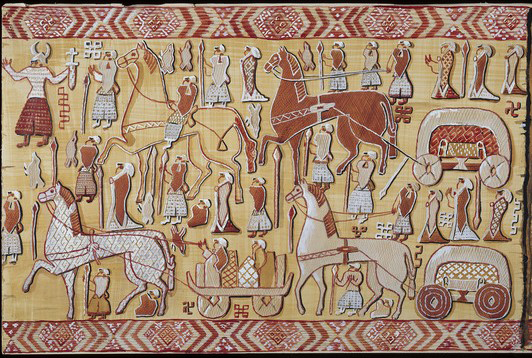
Within the grave chamber, an astonishing array of textiles and textile tools were discovered, marking the largest collection ever found within a single burial site. This collection encompassed various narrow tapestries believed to have lined the chamber, as well as bed linens, finely woven woolen blankets, tablet bands, and a substantial assortment of cloth remnants from garments, sails, tents, rugs, and curtains. Additionally, there were remnants of silk fabrics and silk thread embroideries imported from Central Asia. These textiles exhibited considerable diversity in terms of quality, weaving techniques, and materials. Anne Stine Ingstad, a researcher, categorized them into 19 distinct groups based on their quality and intended use. Coarse wool fabrics, adorned with geometric patterns such as diamonds and crosses, were found abundantly throughout the burial site, likely remnants of draperies used in furnishing. The ornamental tapestries were woven from wool, with a weft made of plant material, possibly flax, which had since deteriorated. These tapestries depicted a range of individuals in processions and engaged in warfare, some clearly in distinctive attire, along with depictions of animals, wagons, and buildings. These scenes possibly represented ritualistic scenarios, suggesting the high status of the older woman interred in the grave.
In total, the burial site contained fifteen different silk materials, primarily cut into narrow ribbons, which may have been used as decorative elements. Multi-colored silk embroideries displayed patterns of tendrils, spirals, animals, and geometric designs, possibly adorning the garments of the deceased women. The collection of textile tools included five different weaving looms, one tablet weaving loom, one manual spindle and distaff, a weaving reed, five balls of wool, a device for winding wool, two yarn reels, two linen smoothers, a smoothing iron, three wooden needles, one pair of iron scissors, and various small implements for spinning and textile work.
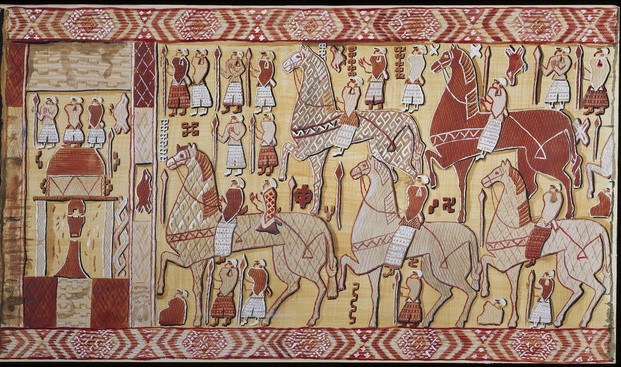
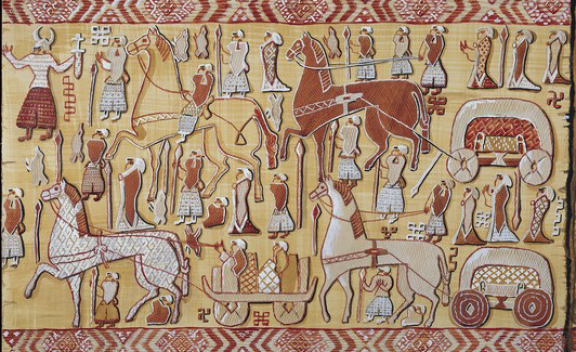
While challenging to decipher, the scene appears to depict a religious procession involving three horse-drawn wagons accompanied by individuals on foot. The two figures riding in the wagon, situated in the lower middle-left section of the combined image above, might symbolize a deity and their priest or priestess. Notably, a ceremonial wagon, intricately adorned with carved figures (shown at the top of the page), was discovered alongside this tapestry.
The front panel of the ceremonial wagon showcases intertwined animals, including cats, which has led some to speculate that the older woman buried in the Oseberg grave might have held the role of a priestess dedicated to Freyja. The other two covered wagons, following the lead wagon, could possibly contain religious artifacts of some sort.
At the forefront of the procession, there is a horned figure on the far left of the image, accompanied by a man holding or accompanied by a four-leafed symbol, possibly mounted on a staff. This same symbol is also seen between the wheels of the lead wagon. The horned figure's relatively larger size suggests a potential divine status, perhaps representing Odin. Behind him, the male figure with the symbol is followed by eight women in procession.
A similar procession featuring one man with raised arms and eight women is seen on stones from the Kivik King's Grave, which also includes a wheeled chariot drawn by two four-legged creatures, likely symbolizing horses. This suggests the ancient and enduring nature of this processional ritual. Additionally, a comparable procession of women in hooded robes can be observed on the Garde Bote Picture Stone from Gotland.
The building positioned in the direct center of the combined image, or on the left side of the right panel, is believed to represent a temple or hall used for ritual activities. Another segment of the tapestry (referenced below) portrays a tree on which human bodies are hung, reminiscent of sacrificial trees described outside heathen temples at Uppsala and Lejre in later written accounts. These elements strongly suggest that the procession depicted in this scene holds religious significance.