

The Oseberg ship was discovered in a large mound near Oseberg Farm, Westfold County, Norway, in 1904. It is considered one of the most well-preserved and intriguing Viking ship finds, despite having been looted during the Middle Ages, with its burial site dating back to 834 AD. Thieves had cut through the ship's bow and the roof of the burial chamber, scattering the remains of two women and stealing all precious metal objects. Nevertheless, the Oseberg burial chamber contained numerous funerary items that the thieves deemed worthless but were of immense value to Viking-era archaeology.
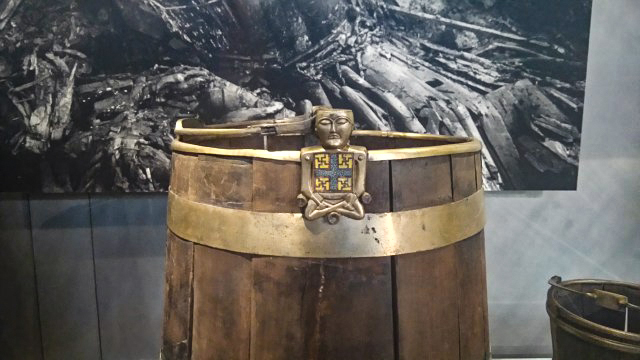
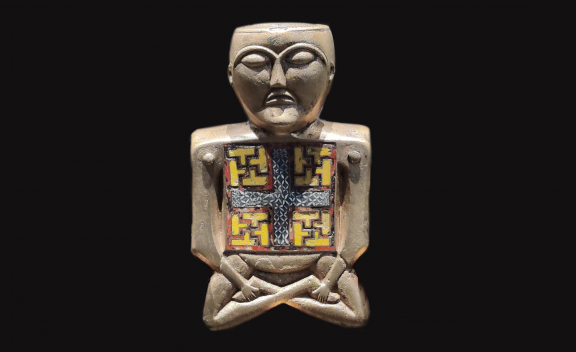
One of the most fascinating discoveries at Oseberg is the so-called "Buddha-bøtte" or Buddha bucket. This is a bucket adorned with two identical figures forming the joints of the bucket handle. Both figures depict a man sitting in the lotus position. Their heads are flat, and their faces have a peaceful and serene expression, with closed eyes. The man's chest features intricate red and yellow chiseled enamel and a millefiori panel. The four swastikas on the enamel decoration are crafted in the typical Buddhist style, where this symbol represents goodness and good fortune.
Interestingly, it is believed that Vikings may have encountered Buddhist missionaries during their expeditions. Evidence of this interaction includes the discovery of a sixth-century Buddha statue from northern India on Helgo Island in Sweden, now exhibited at the Swedish National Antiquities Museum in Stockholm. However, the Oseberg Buddha does not appear to have been imported directly from Asia. Researchers suggest possible origins in Ireland or England. The ornament on Hexham's bucket resembles a flat human head with a broad face and similar eye features. Other parallels include a hanging bowl found in Leland, Norway (located at the Oslo Museum), and a bowl discovered in Maas, Holland (at the Leiden Museum). Both of these bowls have human-shaped handles adorned with red and yellow enamel. Perhaps the most striking resemblance to the Oseberg Buddha can be seen in the anthropomorphic shields on the Myklebostad hanging bowl, which also feature intricate notches in red, yellow, and green, along with millefiori panels. However, in this case, the figure is depicted standing rather than sitting.