



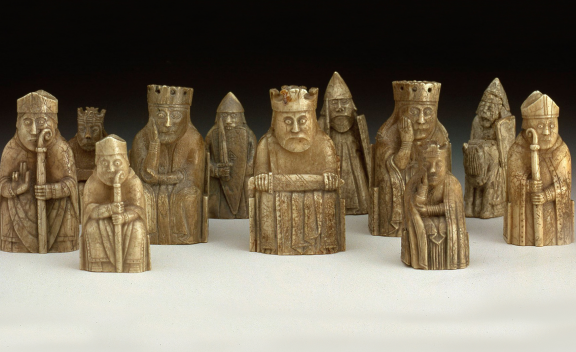
The Lewis Chessmen, also known as the Whig Chessmen, are a group of remarkable chess pieces and other gaming components, primarily carved from walrus ivory. They date back to the 12th century and are among the most distinctive artifacts of medieval chess sets. These chess pieces were discovered in 1831 on the Isle of Lewis in the Outer Hebrides of Scotland. While it's unclear whether the pieces can be assembled into the original complete chess set, they are considered one of the most complete and well-preserved sets from the medieval period.
When the treasure was initially found, it consisted of a total of 93 items, comprising 78 chess pieces, 14 table pieces, and one belt buckle. Presently, 82 of these pieces are part of the collection at the British Museum in London, and the remaining 11 are housed in the National Museum of Scotland in Edinburgh.
Furthermore, a "garder," which is equivalent to a castle or rook, was identified as part of the collection and sold for £735,000 in July 2019. However, four other large pieces and several pawns are still missing from the chess sets.
Although most sources suggest that the pieces were found in Uig Bay on the west coast of Lewis, some experts, including those at the National Museum of Scotland, believe that the more probable location of the hoard is Mealista, also in the parish of Uig and approximately 6 miles (10 km) south of the coast. In the 19th century, the hoard was divided and sold, with the British Museum acquiring the larger portion of 82 pieces.
Sir Frederick Madden, assistant curator of manuscripts at the British Museum, played a crucial role in persuading the trustees to purchase the 82 pieces for eighty guineas (£84). At that time, he mistakenly believed that these constituted the entire hoard. Madden, who was not only a scholar of early vernacular literature but also an enthusiast of chess, began writing an extensive scholarly work about the collection titled "Historical Remarks on the Introduction of the Game of Chess in Europe and the Ancient Chessmen Discovered on the Isle of Lewis," published in Archaeologia XXIV (1832). This work remains an informative and impressive resource today.
The British Museum suggests that the chess pieces were likely crafted in Trondheim, the medieval capital of Norway, during the 12th century. However, some scholars propose that they might have originated from other Scandinavian regions. During this period, the Outer Hebrides, including the Isle of Lewis, were under Norwegian rule.

Selandists Gudmundur Thorarinsson and Einar Einarsson have suggested that chess figures originated in Iceland because only in Iceland were bishops so called at the time, while in other countries they used a name unrelated to the church, they argued. However, this has been challenged by Wolfe, who claimed that the use of bishops originated in England, and by Morten Lilleoren, a Norwegian chess historian and member of the Chess History and Literature Society. The text referred to by the Icelanders is from the early 14th century, while two 13th-century Latin texts from other countries refer to the chess piece as a bishop, and Lewis's chess pieces probably date from the 12th century. In addition, there are many medieval chess bishops of various origins in various museums in Europe and the United States. A bishop that probably predates Lewis' chess pieces was in the collection of Jean-Joseph Marquet de Vasselot and was sold at a Christie's auction in Paris in 2011 with a radiocarbon dating report stating that with a 95% probability the ivory dates to between 790 and 990 AD. It is believed to be an English or German statuette carved in the 12th century. Stylistically, it predates Lewis's chess pieces in that its mitre is worn on its side. According to an essay on the lot with references, the bishop's presence among the chess pieces was a twelfth-century European invention. The inclusion of the bishop reflects his status in the social system of the period, especially in Scandinavia and England, where clergymen played an important role in military conflicts.
