



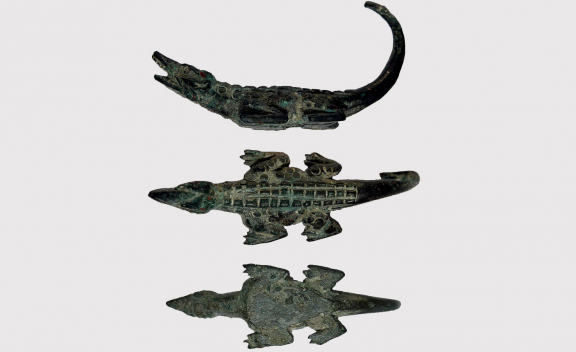
The artifact you describe is a zoomorphic figurine in the shape of a crocodile, made of copper alloy. It is a finely crafted representation of a crocodile with detailed features, including its neck, head, tail, and legs. The crocodile's tail curves upwards, reaching a maximum height of 27.7mm above its flat underside. The legs are bent backward, and each foot has three toes. The upper surface of the crocodile's body is adorned with decorative patterns to mimic the appearance of its leathery skin.
The decoration on the upper body consists of two longitudinal grooves intersected by numerous transverse grooves, creating a pattern of irregular squares and rectangles, typically in groups of three across. The flanks and legs of the crocodile are decorated with a punched circular pattern, although the decoration is not perfectly symmetrical.
The raised head of the crocodile tapers to a pointed snout, with delineated teeth and raised molded eyes. The artifact has a generally dull green patina, with areas of brighter corrosion on the head, tail, and flanks. Some of these areas have spots of orange-brown corrosion product showing through.
The presence of the dull green patina and the craftsmanship of the figurine suggest that it has a certain antiquity. It is most likely of Roman origin. During the Roman period, there was a fascination with Egyptian culture and religious practices. The crocodile was associated with the Egyptian god Sobek, who was linked to the River Nile. Romans are known to have worshipped Sobek, and crocodile figurines and artifacts were used in rituals and as symbols of protection. Your artifact may have been used in a religious or cultural context or simply as a decorative piece during the Roman era.