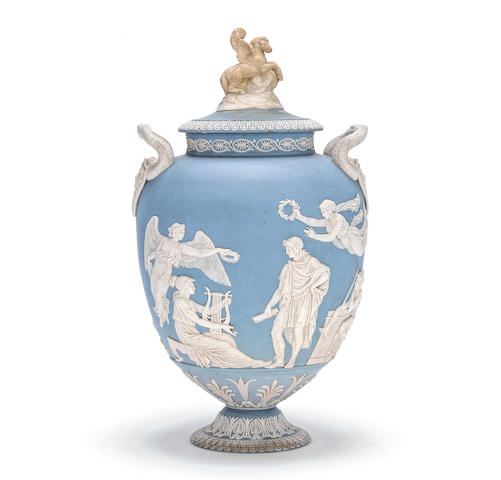


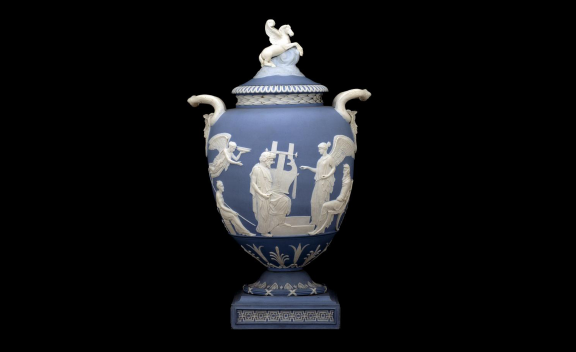
The Pegasus Vase is a remarkable piece of art characterized by its exquisite craftsmanship and materials. The body of the vase is crafted from pale blue jasper, while the relief decorations, handles, and Pegasus motif are made of white jasper. Jasper, in this context, refers to unglazed stoneware that can be painted before the firing process. Josiah Wedgwood I, who lived from 1730 to 1795, perfected this technique by 1775 through a series of experiments aimed at creating a new clay body for producing gemstone-like ceramics.
Josiah Wedgwood created multiple versions of the Pegasus vase using both jasper clay and black basalt. This specific specimen can be confidently attributed to the 18th century. The vase stands out as a masterpiece of pottery, featuring sharp relief decorations on a smooth surface. Wedgwood took great pride in presenting this vase to the British Museum in 1786.
The decorative elements on the vase were designed by the artist John Flaxman, Jr. (1755-1826), who collaborated with Wedgwood. Flaxman drew inspiration from various classical sources; the figures in the central scene are based on an engraving from a Greek vase dating back to the 4th century B.C., while the Medusa heads at the base of the handles were inspired by an engraving of an ancient sandal.
The Pegasus Vase exemplifies the neoclassical characteristics of Wedgwood's artistic style. Josiah Wedgwood, in partnership with businessman Thomas Bentley in 1762, established the Etruria factory. Bentley had a keen interest in the art of the classical Greek and Roman world, which had gained popularity in England following the discovery of Greek vases in Etruscan tombs and recent excavations at Herculaneum and Pompeii. At Wedgwood's factory, Bentley found an artist with both technical and design expertise to lead the creation of a new line of porcelain inspired by these classical models.
One of Wedgwood's signature lines was "jasper ware," which featured a porcelain body made from high-fired clay painted with cobalt oxide to achieve the delicate blue color seen on the vase. The figurines, including the white Pegasus motif, were crafted from translucent porcelain and applied to the surface of the blue clay before firing.