




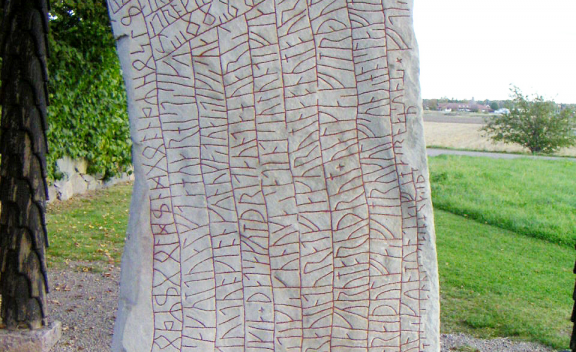
The Rök Stone is undoubtedly one of Sweden's most fascinating runic stones. Erected by a man named Varin in the 9th century, it stands as a memorial to honor the memory of his deceased son. Located near the Röks church in the Östergötland province, the stone's history is shrouded in complexity and continues to intrigue scholars.
This imposing monument rises two and a half meters above the ground, with roughly a meter buried underground. Carved from pale grey, fine-grained granite, it likely originated from a nearby source. Its surface is adorned with runes, featuring approximately 280 on the front side and 450 on the reverse. The runic inscriptions are strategically placed to allow a person standing upright to read the meandering text. Today, the stone is sheltered by a pyramid-shaped roof within an open-air museum established in 1991 to preserve and protect this historic treasure.
To Varin's contemporaries, the Rök Stone must have appeared as a literary and artistic masterpiece. The skilled runestone carver demonstrated a keen sense of form and ornamentation in crafting the decorative text. It's evident that this individual was also a learned poet well-versed in the myths and narratives of the time. The inscriptions seem to challenge the intelligence and education of the reader. While contemporary scholars generally agree on how to read the Rök Stone, its interpretation remains a subject of debate. The stone is composed of intricate legends, enigmatic myths, various epics, and accounts of Varin's own family history.
The monumental size and intricate ornamentation of the Rök Stone strongly suggest that Varin belonged to a prominent and influential family. The inclusion of Thor, a pagan deity, in the latter part of the text may have been an effort to confer divine legitimacy upon Varin and his family. In this context, the stone serves a dual purpose: as a memorial to the lost son and as a symbol of the family's elevated status within their society.