





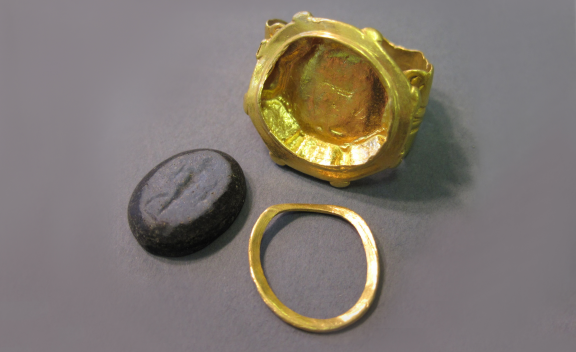
The late Iron Age earthwork located to the southwest of the walled Roman town of Silchester has yielded a fascinating archaeological find. In 1985, after many years without plowing, the surrounding area was plowed, leading to the discovery of an elaborate and ornate gold ring. This ring featured strands of beaded gold wire forming a filigree hoop and an engraved gemstone, known as an intaglio. Such rings were typically crafted during the last decades of the Roman period in Britain and were widespread throughout the Roman Empire. The intaglio on this ring was made of onyx and depicted a satyr and a small cupid. Additionally, four late Roman silver coins were found in close proximity to the ring.
During the following winter, in 1986-1987, more discoveries were made nearby, increasing the total number of coins to 55. While the exact locations of these finds were not specified, an archaeological site visit indicated a limited area of disturbance. It is highly likely that both sets of finds originated from the same hoard. Further small-scale excavations did not reveal any additional late Roman materials or related features. This suggests that the collection was either lost or intentionally hidden, making it most likely a "migratory" hoard.
Of the 55 coins, all but three were heavily rusted and consisted of broken silver specimens from the late 4th century AD. At least 13 of these coins had been "trimmed," a practice that can be dated to the reign of Constantine II (407-411 A.D.). Four more rings were discovered, including two complete gold rings and two fragmentary rings, one of which was made of silver. Due to potential plow damage, it is difficult to determine whether the incomplete and fragmentary rings were originally part of the jeweler's hoard or became damaged after they were concealed.
One of the complete gold rings had an embossed bezel with a glass stone imitating onyx, portraying a satyr carrying a hare. This ring was notably large and heavy. The other complete but deformed gold ring was much smaller and featured a reused glass bead as decoration. Only very fragmentary and mineralized remains were found of the silver ring, which also had an imitation onyx cast glass stone depicting a seated bearded man reading from a scroll, possibly representing a philosopher.
Some of the items mentioned here are on display at the Willis Museum in Basingstoke. The Silchester hoard, while smaller in size, shares compositional similarities with the late Romano-British Thetford hoard discovered in Norfolk in 1979. For instance, two rings from Thetford bear resemblance to a gold ring from Silchester with a glass bead, and a gold plate buckle from Thetford also depicts a satyr, echoing the theme found in the Silchester finds.