



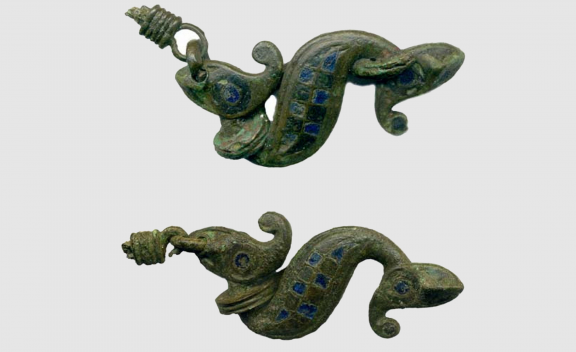
These two dragon-shaped enamel brooches made of lead metal belong to the Roman era, dating approximately from 70 to 120 AD. They were unearthed during excavations conducted by the archaeological section of the Winchester Museum Service on Victoria Road, Winchester, in the mid to late 1970s.
These brooches were discovered within a cremation burial site situated in the cemetery near the north gate of Roman Winchester. The burial also included an impressive collection of 22 pottery vessels, along with possibly a fragment of a bone play set, which had been incinerated on the funeral pyre. It is likely that the individuals who were buried with these brooches used to wear them fastened on each shoulder and connected across the chest with a chain during their lifetime.
Although most dragon-shaped brooches of this type have been found in the northern regions of England, within the tribal territories of the Parisi and the Brigantes, these specimens may have found their way to Winchester through trade. However, there is also a possibility that the person interred in this grave had origins or a connection to those regions. The wealth of grave goods and the Celtic design of the brooches suggest that this individual was of considerable importance, but they were likely not of Roman descent. Due to the cremation process, it is impossible to ascertain the age and gender of the individual, and it should be noted that brooches were used as clothing clasps by both men and women in Roman Britain.