



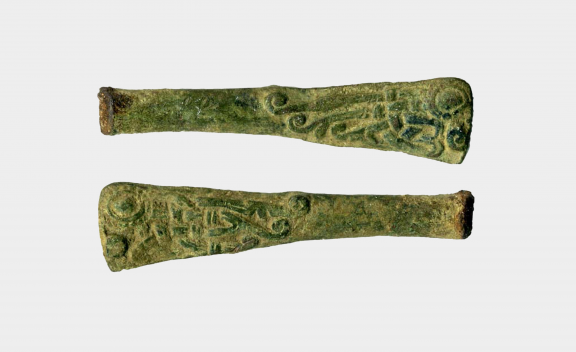
This unusual copper alloy knife handle dates back to the first half of the 11th century AD and belongs to the Anglo-Scandinavian period. It was discovered with the assistance of a metal detector near Winchester, Hampshire.
What sets this knife handle apart is its distinctive material; while knife handles from this era were typically crafted from wood or bone, very few are known to have been made from metal. The handle exhibits traces of the iron blade, which are preserved in the form of corrosion on the narrow end.
The handle's decoration is identical on both sides and follows the Ringerike style, a prevalent artistic style during this period in Scandinavian Northern Europe. The design resembles half of a human or animal mask. This artifact serves as a poignant reminder of the historical context during which it was created—Anglo-Saxon England's connection to the Viking world during the reign of King Canute and his successors. It exemplifies the cultural exchange and influence between these regions during that time.