





The discovery of these objects, dating to the post-medieval period, sheds light on a mysterious burial found during an excavation conducted by Wessex Archaeology at Pinglestone Farm, Old Alresford, in 1997.
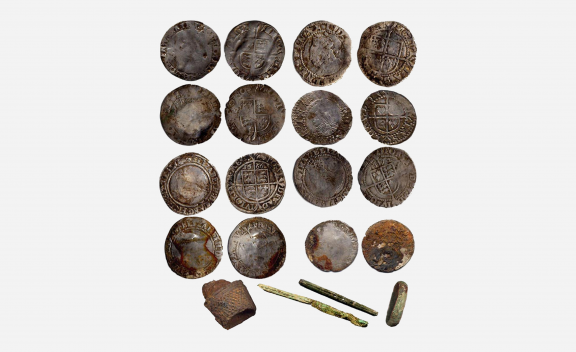
The artifacts were found in close proximity to the body of a man buried under unusual circumstances. He was interred in a shallow grave on a hillside, located outside consecrated ground. The collection of items includes eight coins, a thimble containing a string, a finger ring, and two tags that may have served as purse mounts.
The coins, although minted during Tudor times, are noticeably worn and well-used, suggesting that they were likely buried no earlier than the early 17th century. These coins are of small denominations, including sixpence, a groat (fourpence), threepence, twopence, a penny, and a halfpenny. These denominations would have been sufficient to purchase a winding sheet and conduct some form of funeral ceremony. The presence of the coins on the body suggests that this man was probably not a criminal or a victim of violence. Furthermore, since the coins date the burial to before the English Civil War, death by violence can likely be ruled out.
It is surmised that the man may have succumbed to the plague, and as a precaution to prevent contagion among the living, he was hastily buried away from human habitation. The thimble discovered with him could provide insights into his occupation or simply represent one of his personal possessions, adding an intriguing layer to the story of this enigmatic burial.