



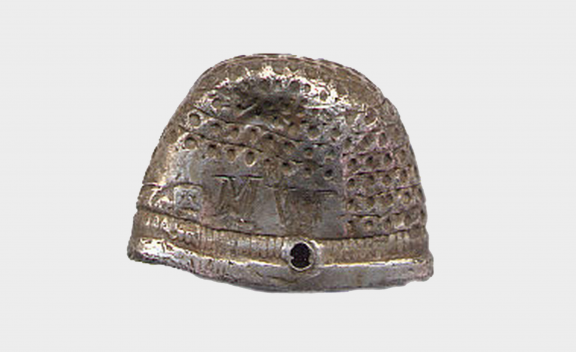
This thimble, which dates back to the Stuart period in the mid to late 17th century AD, was discovered with a metal detector in Bishop's Waltham, Hampshire, in 2001.
The thimble features several interesting details. It bears the maker's mark in the form of the letter "B" enclosed within a shield, indicating the thimble's manufacturer. Additionally, the owner's marks, "MW," have been engraved onto the thimble, although the identities of these individuals have not been established at this time. There is a hole on the rim of the thimble, possibly intended for hanging, which may have been used for storing cotton thread. The loss of this personal item would undoubtedly have been regretted by its owner.
Thimbles have a long history and were created to prevent discomfort while sewing by providing a protective barrier between the fingertips and the blunt end of the needle. It is likely that the earliest thimbles were developed shortly after the invention of sewing itself.
In the United Kingdom, thimbles dating as far back as the 10th century have been discovered, and by the 14th century, they were in widespread use. While there are instances of thimbles made from precious metals—such as Elizabeth I reportedly gifting a thimble adorned with precious stones to one of her ladies-in-waiting—the majority of metal thimbles were crafted from brass. In the medieval era, thimbles were either cast or made from wrought iron. The production of thimbles was often centered in regions known for their brasswork, from Nuremberg in the 15th century to Holland in the 17th century.