






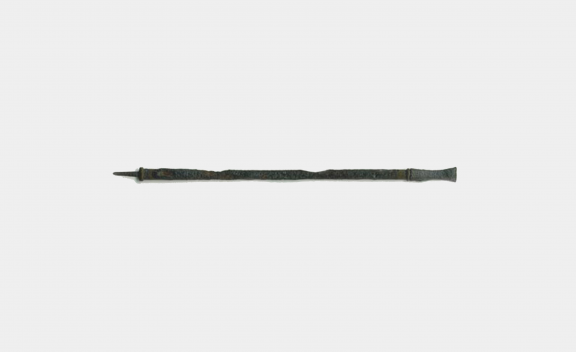
This iron stylus from the Roman era dates back to approximately 180-220 AD. It was discovered during excavations conducted by the archaeological section of the Winchester Museum Service on Victoria Road, Winchester, in the mid to late 1970s.
This stylus is a fine example of the tools used for writing during that period. It features two collars and brass bands that encircle the shank, tip, and eraser. During this time, paper was a costly resource, so writing was commonly done on wooden boards covered with wax. These wooden boards, known as "wax tablets," consisted of wooden leaves fastened together and coated with a layer of wax. People would use a stylus like this one to write on the wax surface. The pointed end was used for writing, while the flat end, often referred to as the eraser, was employed to smooth out and erase the wax surface, making it reusable.
The presence of such writing tools in this period reflects the level of literacy and the widespread use of writing in Roman Britain. What began as inscriptions on Iron Age coins eventually developed into true literacy, with writing being found not only in villas and tribal capitals but also on various types of settlements, as evidenced by the discovery of this stylus in Winchester.