



Anglo-Saxon art experienced a flourishing period in the century leading up to the Norman Conquest of 1066. Its roots trace back to the late ninth century when King Alfred initiated a program of religious revival and learning. He believed this was necessary to counter what he perceived as a waning religious spirit and a neglect of learning among his people. The Viking invasions were viewed as a divine punishment for the English people's sins and their disregard for knowledge. The support of Alfred and his successors created an environment in which individuals of power and wealth were willing to become patrons of the arts, fostering the growth of artisans and artists.
The heart of the Anglo-Saxon kingdom of England, which evolved from Alfred's Wessex, was centered in Winchester. This is evident in the intricate and finely detailed manuscript illuminations produced in England between 966 and 1066. These manuscripts are attributed to the Winchester School or Winchester Art Style. The three major religious institutions in Winchester, namely Old Minster, New Minster, and Nunnaminster, served as centers for these artistic endeavors.
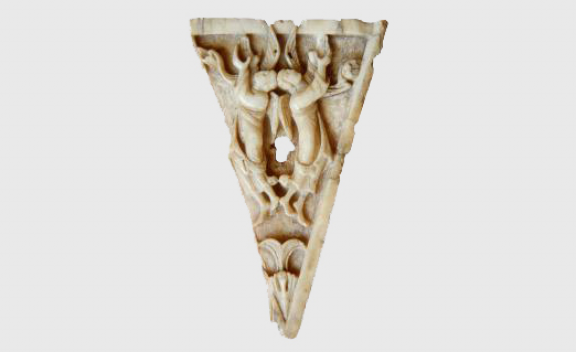
The Winchester style of art is distinguished by several characteristics, including the use of acanthus leaves and tendrils, flowing drapery motifs, and circular arrangements of leaves around birds and animals. Beyond manuscripts, the influence of the Winchester Art Style can also be observed in the ornamentation of objects crafted from various materials, such as ivory, bone, stone, and metal. Many of these objects have been uncovered during excavations in and around Winchester. For example, acanthus motifs and birds, though somewhat crudely carved, can be found on simple bone spoons discovered in the city. These everyday household items reflect how the high artistic standards of this period extended into the design of ordinary objects.