



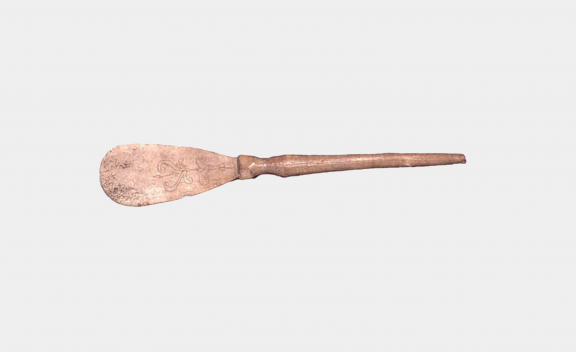
This spoon, dating back to the early 11th century AD during the Anglo-Saxon era, was discovered during archaeological excavations at Westgate Park, Winchester, Hampshire, in 1951. It was found on the site of Queen Elizabeth II's court.
The spoon features an elongated shallow bowl and is adorned with a simply carved head of a bird-like animal at the junction with the handle. Unfortunately, the tip of the handle is missing. The spoon was crafted from a single bone, specifically the radial bone of a cattle or horse. It was uncovered in a domestic waste pit, suggesting that it was used in everyday household activities. Interestingly, despite its apparent use, the surface of the spoon is heavily polished and exhibits no significant signs of wear, suggesting that it may have been relatively new at the time of its loss.
This spoon belongs to the standard late Anglo-Saxon type, but what makes it distinctive is its unique decoration. It features a double acanthus leaf on the top of the bowl and a single acanthus leaf on the back, reflecting the artistic style of the period known as the Winchester Art Style. This particular artifact highlights that the Winchester style was not limited to the rich and powerful but also found its way onto everyday objects used by ordinary people. It serves as a valuable testament to the widespread influence of the Winchester Art Style during this era.