




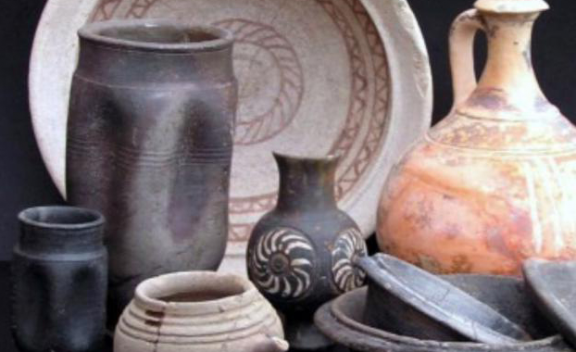
During the third century AD, within the context of Roman Britain, the New Forest area became a significant center for pottery production. The region had been cultivated and cleared from the Late Neolithic period onwards. Over time, soil quality declined, making it less suitable for agriculture. However, the New Forest area had several favorable conditions that made it ideal for pottery production.
The availability of high-quality clay and sand, abundant wood for fuel, and access to flowing water from a network of streams feeding Latchmore Creek all contributed to the development of the pottery industry. As a result, clusters of kilns emerged across a wide area, producing a diverse range of pottery items, from fine crockery to more utilitarian cooking utensils.
One such cluster of kilns was excavated in Lower Sloden in 1966 by Vivian Swan on behalf of the Royal Commission on Historical Monuments. These kilns followed a standard design seen in the New Forest area. The kiln featured a deep furnace chamber below ground level, with thickened walls forming pilasters to support the permanent floor of the furnace. On this floor, pots for firing were placed, and holes allowed hot air to flow from the kiln below into the main chamber. Large pieces of fuel were fed into the kiln through a small stoker and a short chimney.
The New Forest kilns were notable for their depth and size, allowing for very high firing temperatures, typically ranging from 1,000 to 1,250°C. These high temperatures enabled the production of pottery with shiny surfaces, including color-coated pieces, and some vessels had a hard, almost stone-like structure. Glassy materials were also present in parts of the kiln. Vivien Swann, the excavator, drew parallels between the type of kiln and the final products with those found in northern France and Belgium. This led to the theory that the industry in the New Forest might have been established by migrants from these regions, although further research is needed to confirm this.
One fascinating aspect of the excavations was the discovery of fingerprints on the clay lining inside the kiln chamber. These fingerprints were left by potters shaping, molding, and smearing wet clay, providing a tangible connection to the past.
In addition to kilns and vessels, fragments of pottery "wasters" were found. These were discarded pots that had deformed or exploded during firing, and sometimes they were collected and repurposed for kiln repairs.
Despite these archaeological finds, there is limited information available about the pottery-making process and the lives of the potters themselves. A fragment of what might have been part of a potter's wheel, referred to as a "quernstone," was found, but further research would be needed to gain a deeper understanding of the pottery production in the New Forest during this period.
Throughout the 19th and 20th centuries, various archaeologists and antiquarians have explored and studied firing sites in the New Forest. One of the early explorers was Haywood Sumner, and more recently, Mike Fulford conducted research on the industry and the distribution of New Forest wares.